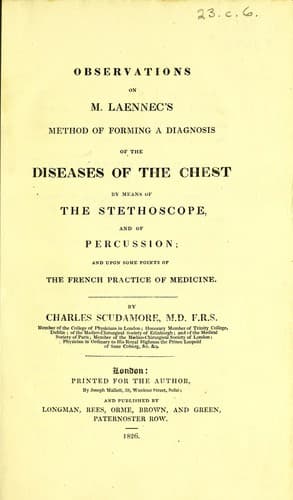
Observations on M. Laennec's method of forming a diagnosis of the diseases of the chest by means of the stethoscope, and of percussion; and upon some points of the French practice of medicineScudamore, Charles
Science
Observations on M. Laennec's method of forming a diagnosis of the diseases of the chest by means of the stethoscope, and of percussion; and upon some points of the French practice of medicine
Scudamore, Charles
Chest -- Diseases -- Diagnosis; Laennec, R. T. H. (René Théophile Hyacinthe), 1781-1826
I think I have here shewn, that by means of the stethoscope,[13] I
obtained much extent, and the progress of the inflammatory symptoms;
and that I was thereby enabled to direct my local treatment with
greater accuracy and advantage, than I could have done, if confined
to the ordinary modes of investigation.
The cases which I have here related, correspond with Laennec’s
description of acute pulmonary catarrh, or bronchitis, a term which I
have been accustomed to consider, more applicable to the inflammation
affecting the larger branches of the bronchia proceeding immediately
from the trachea. When the ramifications extending through the lung
are inflamed, it constitutes a case, either mixed with, or, so much
resembling genuine pneumonia or inflammation of the substance of
the lungs, that, in a practical point of view, the distinction does
not perhaps appear important; but yet, accuracy of diagnosis should
always be desired.
In the case of a young gentleman lately under my care, the symptoms
of inflammation in the lungs were acute, of considerable continuance,
and apparently distinct from any affection of the bronchia, as
the stethoscope did not afford the sonorous rattle, but only the
crepitating and mucous kinds. I do not speak of this as a solitary
example which has occurred to me. At this moment I am attending an
elderly gentleman severely ill with pneumonia; and, in examining his
chest, I cannot discover the sonorous rattle except in one small
point; but I meet with other phenomena, as the crepitating rattle
in one part, and the indication of obstruction of the air cells in
another.
I take this occasion to observe, that in my study of the volumes
of Laennec and Forbes, I do not discover so much mention as my
experience would have led me to expect, of the strong sonorous
rattle, or sharp tones (which in their variety admit of almost
endless comparisons), as being characteristic of the existence of
more or less active inflammation of the bronchia. I have found this
species of rattle serve, in a remarkable manner, to point out the
exact seat of the inflammatory action; and in proof that I have not
been drawn into false conclusions from these particular indications
of the stethoscope, I have been successful in my treatment, and
have ceased to perceive the tones, in the same proportion as the
inflammation has passed away.
Laennec, when speaking of the sonorous rattle, observes, “I am led
by my dissections to believe that it is produced by the partial
obstruction or narrowing of part of the tract of a bronchial tube,
whether this takes place from the pressure of a tumour, or of a
portion of the lung condensed by inflammation, or by the obstruction
produced by a portion of tenacious mucus, or by the partial
thickening of the internal coat of a bronchial ramification.”
Public-domain text, read in full here on John Shaqi.
Reviews
Reviews
No reviews yet
Be the first to share your thoughts on this work.
Join the Discussion
Join the discussion
Sign in to leave a comment or review.
Sign InorCreate an account