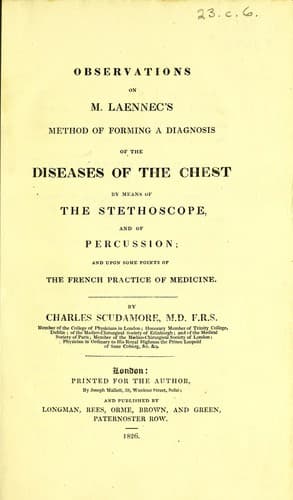
Observations on M. Laennec's method of forming a diagnosis of the diseases of the chest by means of the stethoscope, and of percussion; and upon some points of the French practice of medicine — John Shaqi
Observations on M. Laennec's method of forming a diagnosis of the diseases of the chest by means of the stethoscope, and of percussion; and upon some points of the French practice of medicineScudamore, Charles
Science
Observations on M. Laennec's method of forming a diagnosis of the diseases of the chest by means of the stethoscope, and of percussion; and upon some points of the French practice of medicine
Scudamore, Charles
Chest -- Diseases -- Diagnosis; Laennec, R. T. H. (René Théophile Hyacinthe), 1781-1826
The instrument is used without the stopper, when employed to
ascertain the state of respiration; and with it, either to examine
the action of the heart, or the signs afforded by the voice, in
certain states of disease affecting the lungs, or the pleural
membrane.
In using the stethoscope, care is to be taken that it is kept
perfectly flat upon the part to which it is applied, in order that
sound may not escape, nor air be admitted; for which purpose it is
convenient to hold it at its lower part, while the other end (with
the even surface) should be in close contact with the ear, so that
the aperture of the instrument be in direct communication with the
internal ear. Silk covering, as causing a creaking sort of noise,
and thick dress, as obscuring the sound of respiration, should be
removed; but the linen or flannel dress may remain on the person
without disadvantage. A beginner will be very apt to fail in his
early trials, from inattention to some of these points, and from the
difficulty which at first attends the tuition of the ear.
A skilful use of the instrument requires much practice. It is not,
as some may imagine, a simple matter of hearing a delicate sound.
_Tact_ is necessary, but this will be acquired by perseverance. For
two days of my own study, I was frequently at a loss to distinguish
the peculiar sound or murmur of respiration, and almost despaired of
success. I mention this circumstance, that others beginning with the
practice of this instrument, may not be deterred from proceeding, by
the awkwardness and disappointment which they at first encounter.
At _La Charité_, the best informed students are great enthusiasts in
the practice of this discovery, and regard it as an indispensable
source of information in the diagnosis of the diseases of the
chest. Such reliance on the stethoscope is very natural, when
constant proofs are afforded of the accuracy of opinion formed by
M. Laennec, and others, who are competent in using it. The proofs
of sure diagnosis are derived from dissection; as, necessarily, the
diseases of the lungs and of the heart, allow frequent opportunity of
obtaining this test of the physicians’ judgment.
I will relate one instance which came within my immediate knowledge;
although equally strong proofs are so numerous, that the regular
observer can no more doubt the merits of the stethoscope, than the
mathematician can distrust a resolved problem.
In the clinical record of a case of consumption, M. Laennec had
stated his opinion, that the upper portion of one lung was the
exclusive seat of ulceration. The patient died, and examination
was made. The lungs were removed from the chest, and the expected
evidence of disease did not appear. M. Laennec, making a closer
inspection, discovered that a small part of the upper lobe had been
left in the chest, and upon its removal, the ulceration was found
exactly as he had predicted.
Public-domain text, read in full here on John Shaqi.
Reviews
Reviews
No reviews yet
Be the first to share your thoughts on this work.
Join the Discussion
Join the discussion
Sign in to leave a comment or review.
Sign InorCreate an account