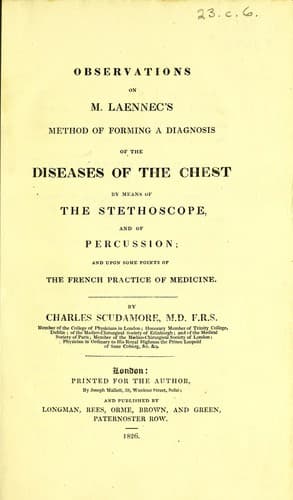
Observations on M. Laennec's method of forming a diagnosis of the diseases of the chest by means of the stethoscope, and of percussion; and upon some points of the French practice of medicineScudamore, Charles
Science
Observations on M. Laennec's method of forming a diagnosis of the diseases of the chest by means of the stethoscope, and of percussion; and upon some points of the French practice of medicine
Scudamore, Charles
Chest -- Diseases -- Diagnosis; Laennec, R. T. H. (René Théophile Hyacinthe), 1781-1826
Some persons assert, that the discovery of the precise situation
of an ulceration of the lung is merely a matter of curiosity, as
when arising from tubercles, they consider it incurable; but surely
this is not a good medical objection. Our art may improve so as to
enable us to remedy these evils; and assuredly our chance of success
will be increased by a knowledge of the seat of tubercles, their
commencement, and their progress. While those persons therefore who
have made use of the stethoscope with success, praise it in terms
which may seem romantic and beyond the truth; others, and perhaps
those chiefly who have never even seen the instrument, speak of it
with ridicule, or censure it as a piece of quackery.
It is not just that any one wholly unacquainted with the stethoscope,
should assume the right of pronouncing an opinion on its properties.
It certainly does not deserve the imputation of quackery; for this
opprobrium belongs to the concealment of a remedy; or to some
mysterious plan of practice, studiously kept secret for the mere
purpose of gain. Candour is most honourable to the educated mind; and
to be sensible of our ignorance on any particular subject, is the
first step to the acquirement of knowledge.
It has been said that the use of the stethoscope may be injurious, by
leading the physician to know too much of the danger in a bad case;
to make him despond and resign the patient to his fate too soon.
Such an observation scarcely requires refutation. In no instance of
dangerous disease can the physician see his way too clearly; and at
all times to know the disease, is at least making a considerable
approach towards the cure. The judgment, the discretion, and the
humanity of the good physician, will be a sure protection to the
patient against any abrupt decision, any gloomy opinion, and much
more against unkind desertion, in the most hopeless circumstances of
disease.
The following case serves to shew the converse proposition, and
the happy purpose to which superior knowledge and discernment were
applied.
M. Laennec was consulted in the case of a gentleman who was supposed
to be dying from phthisis pulmonalis, and in a state so desperate,
that he was not expected by his medical attendant to survive more
than two or three days.
M. Laennec made his usual investigation, and persuaded himself that
the case had been mistaken, and that the alarming symptoms did not
arise from ulceration of the lungs, but from empyema, or purulent
collection within the pleuræ. He strongly recommended that the
operation for this disease should be performed; and, after a little
hesitation and delay, his advice was adopted. A large quantity of pus
was evacuated, and immediate relief was afforded. The amendment was
rapid, and the progress of cure so favourable, that the gentleman
recovered his health in less than three months.
Public-domain text, read in full here on John Shaqi.
Reviews
Reviews
No reviews yet
Be the first to share your thoughts on this work.
Join the Discussion
Join the discussion
Sign in to leave a comment or review.
Sign InorCreate an account