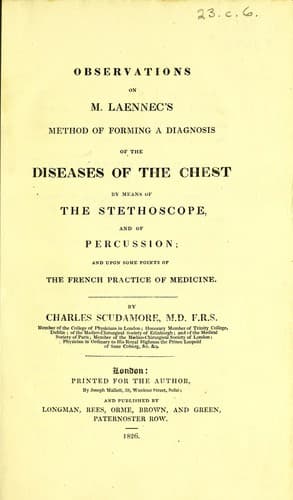
Observations on M. Laennec's method of forming a diagnosis of the diseases of the chest by means of the stethoscope, and of percussion; and upon some points of the French practice of medicine — John Shaqi
Observations on M. Laennec's method of forming a diagnosis of the diseases of the chest by means of the stethoscope, and of percussion; and upon some points of the French practice of medicineScudamore, Charles
Science
Observations on M. Laennec's method of forming a diagnosis of the diseases of the chest by means of the stethoscope, and of percussion; and upon some points of the French practice of medicine
Scudamore, Charles
Chest -- Diseases -- Diagnosis; Laennec, R. T. H. (René Théophile Hyacinthe), 1781-1826
In thus rendering my homage to the merits and science of M. Laennec,
I do not wish it to be thought, that I consider even his authority
as infallible; but it is nothing more than is justly due to the new
practice, to admit, that it may become of very great importance; and,
that by no other mode can we examine the interior state of the chest,
with equal accuracy.
Let it be further remarked, that we are not required to lay aside any
of our ordinary methods of investigation: This additional mode comes
to our aid in cases of obscurity and difficulty. If the physician
of long experience be so confident in his powers of diagnosis, that
he rejects this invention as unnecessary for his purpose, it need
not follow that he should disapprove of it for others who are less
experienced, and are more diffident of their skill and penetration.
Most assuredly it is a great help to the judgment; and I am fully
persuaded, that, in proportion as it is understood, it will be more
generally received, and more highly esteemed.
If the naked ear be applied to any part of the chest, it is made
sensible of the entrance of the air into the cells of the lungs; and
the beginner in this study will receive the impression more fully
and sensibly, than by the medium of the stethoscope, because the
vibrations are collected from a larger surface; but it is a less
accurate method, and much less analytical. He may with advantage
practise with the naked ear occasionally, in order to become familiar
with the sounds of respiration; but under many circumstances, such
a mode is inconvenient and inapplicable. The listening by the ear
only is technically called, immediate auscultation; and by the
stethoscope, mediate auscultation.
In examining the chest of a person whose respiration is calm, we
should desire that it be made purposely quicker, and stronger;
but not so audibly as to cause confusion by that external sound.
The perception afforded to the auscultator by healthy lungs, is
that of air entering a cavity, as it were with a gentle stream
of sound. If the pupil first apply his naked ear to the chest,
he will have a clear idea of what he has to expect. As a general
rule, in making our investigation of the state of the lungs, the
stethoscope should be applied immediately under the clavicle, near
the axilla; and the learner will do well to choose the right side,
lest he become confused by the action of the heart. In seeking for
ordinary respiration, it should not be applied near the trachea, as
the stronger action of the air in the bronchial tubes would mislead
the ear. To ascertain the state of the posterior part of the lungs,
the instrument is to be applied on the scapula, above or below the
spinous process.
Public-domain text, read in full here on John Shaqi.
Reviews
Reviews
No reviews yet
Be the first to share your thoughts on this work.
Join the Discussion
Join the discussion
Sign in to leave a comment or review.
Sign InorCreate an account