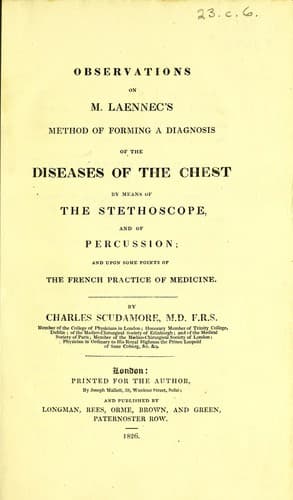
Observations on M. Laennec's method of forming a diagnosis of the diseases of the chest by means of the stethoscope, and of percussion; and upon some points of the French practice of medicine — John Shaqi
Observations on M. Laennec's method of forming a diagnosis of the diseases of the chest by means of the stethoscope, and of percussion; and upon some points of the French practice of medicineScudamore, Charles
Science
Observations on M. Laennec's method of forming a diagnosis of the diseases of the chest by means of the stethoscope, and of percussion; and upon some points of the French practice of medicine
Scudamore, Charles
Chest -- Diseases -- Diagnosis; Laennec, R. T. H. (René Théophile Hyacinthe), 1781-1826
In my own practice, I have derived the utmost advantage from the
use of the stethoscope in cases of pneumonia, with regard to local
treatment. When we find a patient ill with severe symptoms arising
from inflammation of the lungs, we do not require the aid of
auscultation to determine us in employing the lancet as our first and
most important remedy; but we may desire immediately to join with the
general bleeding, local depletion; and, most commonly, the period
arrives when we wish to use local treatment exclusively, by cupping
or leeches, and blisters. Under such circumstances, it is of the
utmost importance that we should be able to ascertain the exact seat
of the inflammation; and when, as commonly happens in pneumonia, the
patient cannot direct us by any sensation of pain, but is labouring
under a general sense of oppression and suffocation; we resort to the
stethoscope as a positive and most valuable source of instruction.
Even when it is manifested to us by ordinary indications, that the
inflammatory action is prevailing on one side of the chest, it is of
great advantage that we can detect, by means of the instrument, the
particular part of the lungs most affected. I shall illustrate the
truth of these remarks by the recital of a few cases.
A gentleman dangerously ill with inflammation of the lungs, which
had supervened on an attack of asthma, experienced, in the evening,
a renewal of the feelings of suffocation, which, in the morning had
been relieved by copious bleeding from the arm. In the middle of the
upper part of the chest, he had a severe sensation of tightness,
but was not conscious that the lungs were affected more on one side
than the other. His cough was most urgent. The stethoscope, applied
to the lower part of the right side, conveyed to the ear a strong
sonorous rattle, both on inspiration and expiration, much resembling
the sounds of loud snoring. These sounds could not be detected in any
other part of the chest. In addition, therefore, to a fresh bleeding
from the arm, cupping was used very freely at this part, and with
evident good effect. Almost immediately the sounds abated. Two days
after, leeches and a large blister were used with further benefit;
and the actual relief of the patient perfectly corresponded with
the improving indications afforded by the stethoscope. Occasional
bleedings from the arm were afterwards required; but the inflammation
was finally subdued, and the constitution was restored to its
previous state; this gentleman being habitually subject to spasmodic
asthma.
Public-domain text, read in full here on John Shaqi.
Reviews
Reviews
No reviews yet
Be the first to share your thoughts on this work.
Join the Discussion
Join the discussion
Sign in to leave a comment or review.
Sign InorCreate an account