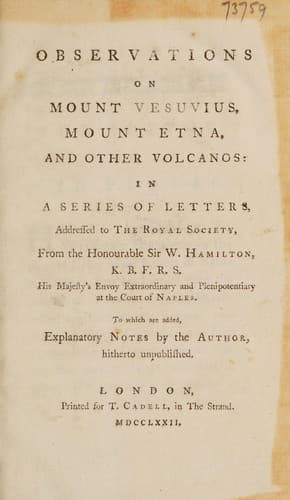
Observations on Mount Vesuvius, Mount Etna, and Other Volcanos — John Shaqi
Observations on Mount Vesuvius, Mount Etna, and Other VolcanosHamilton, William, Sir
Science
Observations on Mount Vesuvius, Mount Etna, and Other Volcanos
Hamilton, William, Sir
Etna, Mount (Italy) -- Early works to 1800; Vesuvius (Italy) -- Early works to 1800; Volcanoes -- Italy -- Early works to 1800
Saturday 24th, the lava ceased running; the extent of the lava, from
the spot C (Plate I.), where I saw it break out, to its extremity F,
where it surrounded the chapel of Saint Vito, is above six miles. In the
Atrio di Cavallo, and in a deep valley that lies between Vesuvius (1.)
and the hermitage (3.), the lava is in some places near two miles broad,
and in most places from sixty to seventy feet deep; at (4.), the lava
ran down a hollow way, called Fossa grande, made by the currents of rain
water; it is not less than two hundred feet deep, and a hundred broad;
yet the lava in one place has filled it up. I could not have believed
that so great a quantity of matter could have been thrown out in so
short a time, if I had not since examined the whole course of the lava
myself. This great compact body will certainly retain some heat many
months[11]; at this time, much rain having fallen for some days past,
the lava smoaks, as if it ran afresh: and about ten days ago, when I was
up the mountain with Lord Stormont, we thrust sticks into the crevices
of the lava, which took fire immediately: But to proceed with my
journal.
The 24th, Vesuvius continued to throw up stones as on the preceding
days: during the whole of this eruption, it had differed in this
circumstance from the eruption of 1766, when no stones were thrown out
of the crater from the moment the lava ran freely.
Sunday 25th, small ashes fell all day at Naples; they issued from the
crater of the Volcano, and formed a vast column, as black as the
mountain itself, so that the shadow of it was marked out on the surface
of the sea; continual flashes of forked or zig-zag lightning shot from
this black column, the thunder of which was heard in the neighbourhood
of the mountain, but not at Naples: there were no clouds in the sky at
this time, except those of smoak issuing from the crater of Vesuvius. I
was much pleased with this phaenomenon, which I had not seen before in
that perfection[12].
Monday 26th, the smoak continued, but not so thick, neither were there
any flashes of the mountain lightning. As no lava has appeared after
this column of black smoak, which must have been occasioned by some
inward operation of fire; I am apt to think, that the lava, which should
naturally have followed this symptom, has broke its way into some deeper
cavern, where it is silently brooding future mischief; and I shall be
much mistaken if it does not break out a few months hence.
Tuesday 27th, no more black smoak, nor any signs of eruption.
Thus, my Lord, I have had the honor of giving your Lordship a faithful
narrative of my observations during this eruption, which is universally
allowed to have been the most violent of this century; and I shall be
happy, if it should meet with your approbation, and that of the Royal
Society, if your Lordship should think it worthy of being communicated
to so respectable a body.
Public-domain text, read in full here on John Shaqi.
Reviews
Reviews
No reviews yet
Be the first to share your thoughts on this work.
Join the Discussion
Join the discussion
Sign in to leave a comment or review.
Sign InorCreate an account