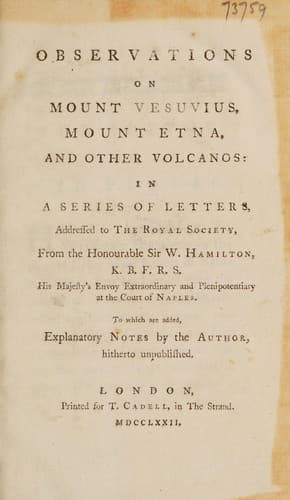
Observations on Mount Vesuvius, Mount Etna, and Other VolcanosHamilton, William, Sir
Science
Observations on Mount Vesuvius, Mount Etna, and Other Volcanos
Hamilton, William, Sir
Etna, Mount (Italy) -- Early works to 1800; Vesuvius (Italy) -- Early works to 1800; Volcanoes -- Italy -- Early works to 1800
I have just sent a present to the British Museum of a complete
collection of every sort of matter produced by Mount Vesuvius, which I
have been collecting with some pains for these three years past; and it
will be a great satisfaction to me, if, by the means of this collection,
some of my countrymen, learned in natural history, may be enabled to
make some useful discoveries relative to Volcanos[13].
I have also accompanied that collection with a view of a current of
lava from Mount Vesuvius; it is painted with transparent colours, and,
when lighted up with lamps behind it, gives a much better idea of
Vesuvius, than is possible to be given by any other sort of painting.
I have the honor to be,
My LORD,
Your Lordship's
Most obedient
and most humble servant,
WILLIAM HAMILTON.
[Illustration: _Plate I._
View of the GREAT ERUPTION of VESUVIUS 1767 from Portici.]
PLATE I.
A. Crater of Mount Vesuvius.
B. Mouth from whence came the lava of 1766; and which opened
afresh, October 19, 1767, and produced the conflagration
represented in Plate II.
C. The mouth which opened at 12 o'clock, October 19, 1767, whilst
I was at the spot marked X; from thence came all the lava
represented in Plate I.
D. The lava.
E. Mouth from whence the lava flowed at eight o'clock, October 19,
when the eruption began first.
F. Chapel of Saint Vito, surrounded with lava.
1. Vesuvius.
2. Mountain of Somma.
3. Hermitage, between which and Vesuvius there is a deep valley
two miles broad.
4. The Fossa Grande.
5. His Sicilian Majesty's Palace at Portici.
6. Church of Pugliano.
7. Calmaldolese Convent, near which is my Villa.
8. Saint Jorio.
9. Barra.
10. Spot, under which lies Herculaneum.
[Illustration: _Plate II._
View of the GREAT ERUPTION of VESUVIUS 1767, from Torre dell'
Annunziata.]
PLATE II.
A. Crater of Vesuvius.
B. Mouth, from whence came the lava of 1766, and which opened
afresh at two o'clock, October 19, 1767, and caused the
conflagration on this side of the mountain.
C. Mouth which opened at 12 o'clock, October 19, 1767, whilst I
was at the spot X, and which produced all the lava
represented in Plate I.
D. Rivulets of lava, which flowed from the crater, and united with
the great river E.
F. Extremities of the lava, about five miles from B.
1. Mountain of Somma.
2. Mount Vesuvius.
3. Montagna di Trecase.
4. Trecase.
5. Oratorio di Bosco.
6. Ottaiano.
[Illustration: _Plate III._
_The ancient Crater of Mount Vesuvius._
_With the gradual increase of the little Mountain within the Crater._
Public-domain text, read in full here on John Shaqi.
Reviews
Reviews
No reviews yet
Be the first to share your thoughts on this work.
Join the Discussion
Join the discussion
Sign in to leave a comment or review.
Sign InorCreate an account