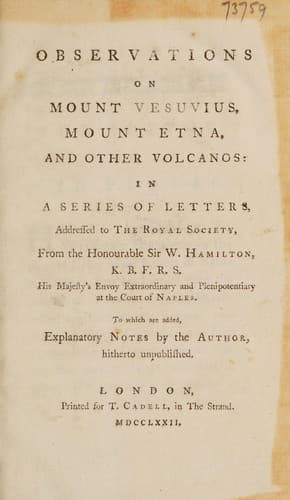
Observations on Mount Vesuvius, Mount Etna, and Other VolcanosHamilton, William, Sir
Science
Observations on Mount Vesuvius, Mount Etna, and Other Volcanos
Hamilton, William, Sir
Etna, Mount (Italy) -- Early works to 1800; Vesuvius (Italy) -- Early works to 1800; Volcanoes -- Italy -- Early works to 1800
After having passed the morning of the 25th in these observations, we
proceeded through the second or middle region of Etna, called La
Selvosa, _the woody_, than which nothing can be more beautiful. On every
side are mountains, or fragments of mountains, that have been thrown up
by various ancient explosions; there are some near as high as Mount
Vesuvius; one in particular (as the Canon our guide assured me, having
measured it) is little less than one mile in perpendicular height, and
five in circumference at its basis. They are all more or less covered,
even within their craters, as well as the rich vallies between them,
with the largest oak, chesnut, and firr trees, I ever saw any where; and
indeed it is from hence chiefly, that his Sicilian Majesty's dockyards
are supplied with timber. As this part of Etna was famous for its timber
in the time of the Tyrants of Syracusa, and as it requires the great
length of time I have already mentioned before the matter is fit for
vegetation, we may conceive the great age of this respectable Volcano.
The chesnut-trees predominated in the parts through which we passed,
and, though of a very great size, are not to be compared to some on
another part of the Regione Selvosa, called Carpinetto. I have been told
by many, and particularly by our guide, who had measured the largest
there, called La Castagna Cento Cavalli, that it is upwards of
twenty-eight Neapolitan canes in circumference. Now as a Neapolitan cane
is two yards and half a quarter, English measure, you may judge, Sir, of
the immense size of this famous tree[21]. It is hollow from age, but
there is another near it almost as large and sound. As it would have
required a journey of two days to have visited this extraordinary tree,
and the weather being already very hot, I did not see it. It is amazing
to me, that trees should flourish in so shallow a soil; for they cannot
penetrate deep without meeting with a rock of lava; and indeed great
part of the roots of the large trees we passed by are above ground, and
have acquired, by the impression of the air, a bark like that of their
branches. In this part of the mountain, are the finest horned cattle in
Sicily; we remarked in general, that the horns of the Sicilian cattle
are near twice the size of any we had ever seen; the cattle themselves
are of the common size. We passed by the lava of the last eruption in
the year 1766, which has destroyed above four miles square of the
beautiful wood abovementioned. The mountain raised by this eruption
abounds with sulphur and salts, exactly resembling those of Vesuvius;
specimens of which I sent some time ago to the late Lord Morton.
Public-domain text, read in full here on John Shaqi.
Reviews
Reviews
No reviews yet
Be the first to share your thoughts on this work.
Join the Discussion
Join the discussion
Sign in to leave a comment or review.
Sign InorCreate an account