Observations on Mount Vesuvius, Mount Etna, and Other Volcanos — John Shaqi
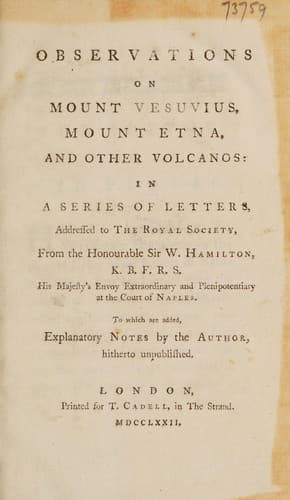
Observations on Mount Vesuvius, Mount Etna, and Other VolcanosHamilton, William, Sir
Science
Observations on Mount Vesuvius, Mount Etna, and Other Volcanos
Hamilton, William, Sir
Etna, Mount (Italy) -- Early works to 1800; Vesuvius (Italy) -- Early works to 1800; Volcanoes -- Italy -- Early works to 1800
In about five hours from the time we had left the convent of St. Nicolo
dell' Arena, we arrived at the borders of the third region, called La
Netta, or Scoperta, _clean_ or _uncovered_, where we found a very sharp
air indeed; so that, in the same day, the four seasons of the year were
sensibly felt by us, on this mountain; excessive summer heats in the
Piemontese, spring and autumn temperature in the middle, and extreme
cold of winter in the upper region. I could perceive, as we approached
the latter, a gradual decrease of vegetation; and from large timber
trees we came to the small shrubs and plants of the northern climates: I
observed quantities of juniper and tanzey; our guide told us that later
in the season there are numberless curious plants here, and that in some
parts there are rhubarb and saffron in plenty. In Carrera's History of
Catania, there is a list of all the plants and herbs of Etna in
alphabetical order.
Night coming on, we here pitched a tent, and made a good fire, which was
very necessary; for without it, and very warm cloathing, we should
surely have perished with cold; and at one of the clock in the morning
of the 26th, we pursued our journey towards the great crater. We passed
over vallies of snow, that never melts, except there is an eruption of
lava from the upper crater, which scarcely ever happens; the great
eruptions are usually from the middle region, the inflamed matter
finding (as I suppose) its passage through some weak part, long before
it can rise to the excessive height of the upper region, the great mouth
on the summit only serving as a common chimney to the Volcano. In many
places the snow is covered with a bed of ashes, thrown out of the
crater, and the sun melting it in some parts makes this ground
treacherous; but as we had with us, besides our guide, a peasant well
accustomed to these vallies, we arrived safe at the foot of the little
mountain of ashes that crowns Etna, about an hour before the rising of
the sun. This mountain is situated in a gently inclining plain of about
nine miles in circumference; it is about a quarter of a mile
perpendicular in height, very steep, but not quite so steep as Vesuvius;
it has been thrown up within these twenty-five or thirty years, as many
people at Catania have told me they remembered when there was only a
large chasm or crater, in the midst of the abovementioned plain. Till
now, the ascent had been so gradual (for the top of Etna is not less
than thirty miles from Catania, from whence the ascent begins) as not to
have been the least fatiguing; and if it had not been for the snow, we
might have rode upon our mules to the very foot of the little mountain,
higher than which the Canon our guide had never been: but as I saw that
this little mountain was composed in the same manner as the top of
Vesuvius, which, notwithstanding the smoak issuing from every pore, is
solid and firm, I made no scruple of going up to the edge of the crater;
and my companions followed.
Public-domain text, read in full here on John Shaqi.
Reviews
Reviews
No reviews yet
Be the first to share your thoughts on this work.
Join the Discussion
Join the discussion
Sign in to leave a comment or review.
Sign InorCreate an account