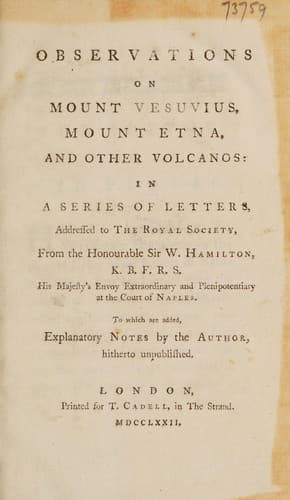
Observations on Mount Vesuvius, Mount Etna, and Other VolcanosHamilton, William, Sir
Science
Observations on Mount Vesuvius, Mount Etna, and Other Volcanos
Hamilton, William, Sir
Etna, Mount (Italy) -- Early works to 1800; Vesuvius (Italy) -- Early works to 1800; Volcanoes -- Italy -- Early works to 1800
To account for the very great difference of the matters that cover
Herculaneum and Pompeii, I have often thought that, in the eruption of
79, the mountain must have been open in more than one place. A passage
in Pliny's letter to Tacitus seems to say as much: "Interim e Vesuvio
monte pluribus locis latissimae flammae, atque incendia relucebant, quorum
fulgor et claritas tenebras noctis pellebat:" so that very probably the
matter that covers Pompeii proceeded from a mouth, or crater, much
nearer to it than is the great mouth of the Volcano, from whence came
the matter that covers Herculaneum. This matter might nevertheless be
said to have proceeded from Vesuvius, just as the eruption in the year
1760, which was quite independent of the great crater (being four miles
from it), is properly called an eruption of Vesuvius.
In the beginning of eruptions, Volcanos frequently throw up water mixed
with the ashes. Vesuvius did so in the eruption of 1631, according to
the testimony of many contemporary writers. The same circumstance
happened in 1669, according to the account of Ignazzio Sorrentino, who,
by his history of Mount Vesuvius, printed at Naples in 1734, has shewn
himself to have been a very accurate observer of the phaenomena of the
Volcano, for many years that he lived at Torre del Greco, situated at
the foot of it. At the beginning of the formation of the new mountain,
near Puzzole, water was mixed with the ashes thrown up, as will be seen
in two very curious and particular accounts of the formation of that
mountain, which I shall have the pleasure of communicating to you
presently; and in 1755, Etna threw up a quantity of water in the
beginning of an eruption, as is mentioned in the letter I sent you last
year upon the subject of that magnificent Volcano[32]. Ulloa likewise
mentions this circumstance of water attending the eruptions of Volcanos
in America. Whenever therefore I find a _tufa_ composed exactly like
that which immediately covers Herculaneum, and undoubtedly proceeded
from Vesuvius, I conclude such a _tufa_ to have been produced by water
mixing with the erupted matter at the time of an explosion occasioned by
subterraneous fire; and this observation, I believe, will be of more use
than any other, in pointing out those parts of the present _terra
firma_, that have been formed by explosion. I am convinced, it has often
happened that subterraneous fires and exhalations, after having been
pent up and confined for some time, and been the cause of earthquakes,
have forced their passage, and in venting themselves formed mountains of
the matter that confined them, as you will see was the case near
Puzzole in the year 1538, and by evident signs has been so before, in
many parts of the neighbourhood of Puzzole; without creating a regular
Volcano. The materials of such mountains will have but little appearance
of having been produced by fire, to any one unaccustomed to make
observations upon the different nature of Volcanos.
Public-domain text, read in full here on John Shaqi.
Reviews
Reviews
No reviews yet
Be the first to share your thoughts on this work.
Join the Discussion
Join the discussion
Sign in to leave a comment or review.
Sign InorCreate an account