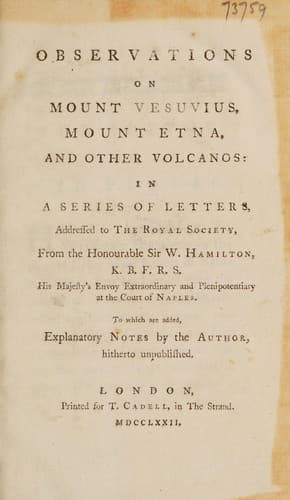
Observations on Mount Vesuvius, Mount Etna, and Other Volcanos — John Shaqi
Observations on Mount Vesuvius, Mount Etna, and Other VolcanosHamilton, William, Sir
Science
Observations on Mount Vesuvius, Mount Etna, and Other Volcanos
Hamilton, William, Sir
Etna, Mount (Italy) -- Early works to 1800; Vesuvius (Italy) -- Early works to 1800; Volcanoes -- Italy -- Early works to 1800
If it were allowed to make a comparison between the earth and a human
body, one might consider a country replete with combustibles occasioning
explosions (which is surely the case here) to be like a body full of
humours. When these humours concentre in one part, and form a great
tumour out of which they are discharged freely, the body is less
agitated; but when, by any accident, the humours are checked, and do not
find free passage through their usual channel, the body is agitated, and
tumours appear in other parts of that body, but soon after the humours
return again to their former channel. In a similar manner one may
conceive Vesuvius to be the present great channel, through which nature
discharges some of the foul humours of the earth: when these humours are
checked by any accident or stoppage in this channel for any considerable
time, earthquakes will be frequent in its neighbourhood, and explosions
may be apprehended even at some distance from it. This was the case in
the year 1538, Vesuvius having been quiet for near 400 years. There was
no eruption from its great crater, from the year 1139 to the great
eruption of 1631, and the top of the mountain began to lose all signs of
fire. As it is not foreign to my purpose, and will serve to shew how
greatly they are mistaken, who place the seat of the fire in the centre,
or towards the top, of a Volcano; I will give you a curious description
of the state of the crater of Vesuvius, after having been free from
eruption 492 years, as related by Bracini, who descended into it not
long before the eruption of 1631: "The crater was five miles in
circumference, and about a thousand paces deep; its sides were covered
with brush wood, and at the bottom there was a plain on which cattle
grazed. In the woody parts, boars frequently harboured; in the midst of
the plain, within the crater, was a narrow passage, through which, by a
winding path, you could descend about a mile amongst rocks and stones,
till you came to another more spacious plain covered with ashes: in this
plain were three little pools, placed in a triangular form, one towards
the East, of hot water, corrosive and bitter beyond measure; another
towards the West, of water salter than that of the sea; the third of hot
water, that had no particular taste."
Public-domain text, read in full here on John Shaqi.
Reviews
Reviews
No reviews yet
Be the first to share your thoughts on this work.
Join the Discussion
Join the discussion
Sign in to leave a comment or review.
Sign InorCreate an account