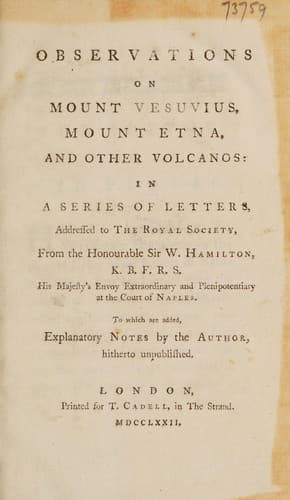
Observations on Mount Vesuvius, Mount Etna, and Other VolcanosHamilton, William, Sir
Science
Observations on Mount Vesuvius, Mount Etna, and Other Volcanos
Hamilton, William, Sir
Etna, Mount (Italy) -- Early works to 1800; Vesuvius (Italy) -- Early works to 1800; Volcanoes -- Italy -- Early works to 1800
The great increase of the cone of Vesuvius, from that time to this,
naturally induces one to conclude, that the whole of the cone was raised
in the like manner; and that the part of Vesuvius, called Somma, which
is now considered as a distinct mountain from it, was composed in the
same manner. This may plainly be perceived, by examining its interior
and exterior form, and the strata of lava and burnt matter of which it
is composed. The ancients, in describing Vesuvius, never mention two
mountains. Strabo, Dio, Vitruvius, all agree, that Vesuvius, in their
time, shewed signs of having formerly erupted[33], and the first
compares the crater on its top to an amphitheatre. The mountain now
called Somma was, I believe, that which the ancients called Vesuvius:
its outside form is conical; its inside, instead of an amphitheatre, is
now like a great theatre. I suppose the eruption in Pliny's time to have
thrown down that part of the cone next the sea, which would naturally
have left it in its present state; and that the conical mountain, or
existing Vesuvius, has been raised by the succeeding eruptions: all my
observations confirm this opinion. I have seen antient lavas in the
plain on the other side of Somma, which could never have proceeded from
the present Vesuvius. Serao, a celebrated physician now living at
Naples, in the introduction of his account of the eruption of Vesuvius
in 1737 (in which account many of the phaenomena of the Volcano are
recorded and very well accounted for), says, that at the convent of
Dominican Fryars, called the Madona del Arco, some years ago, in sinking
a well, at a hundred feet depth, a lava was discovered, and soon after
another; so that, in less than three hundred feet depth, the lavas of
four eruptions were found. From the situation of this convent, it is
clear beyond a doubt, that these lavas proceeded from the mountain
called Somma, as they are quite out of the reach of the existing
Volcano.
From these circumstances, and from repeated observations I have made in
the neighbourhood of Vesuvius, I am sure that no virgin soil is to be
found there, and that all is composed of different strata of erupted
matter, even to a great depth below the level of the sea. In short, I
have not any doubt in my own mind, but that this Volcano took its rise
from the bottom of the sea; and as the whole plain between Vesuvius and
the mountains behind Caserta, which is the best part of the Campagna
Felice, is (under its good soil) composed of burnt matter, I imagine the
sea to have washed the feet of those mountains, until the subterraneous
fires began to operate, at a period certainly of a most remote
antiquity.
Public-domain text, read in full here on John Shaqi.
Reviews
Reviews
No reviews yet
Be the first to share your thoughts on this work.
Join the Discussion
Join the discussion
Sign in to leave a comment or review.
Sign InorCreate an account