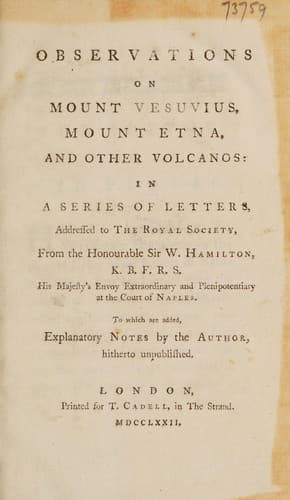
Observations on Mount Vesuvius, Mount Etna, and Other VolcanosHamilton, William, Sir
Science
Observations on Mount Vesuvius, Mount Etna, and Other Volcanos
Hamilton, William, Sir
Etna, Mount (Italy) -- Early works to 1800; Vesuvius (Italy) -- Early works to 1800; Volcanoes -- Italy -- Early works to 1800
like heavy artillery when two armies are engaged. The third day the
eruption ceased, so that the mountain made its appearance uncovered, to
the no small astonishment of every one who saw it. On this day, when I
went up with many people to the top of this mountain; I saw down into
its mouth, which was a round concavity of about a quarter of a mile in
circumference, in the middle of which the stones that had fallen were
boiling up, just as in a great cauldron of water that boils on the
fire. The fourth day it began to throw up again, and the seventh much
more, but still with less violence than the first night; it was at this
time that many people, who were unfortunately on the mountain, were
either suddenly covered with ashes, smothered with smoak, or, knocked
down by stones, burnt by the flame, and left dead on the spot. The smoak
continues to this day[39], and you often see in the night-time fire in
the midst of it. Finally, to complete the history of this new and
unforeseen event, in many parts of the new-made mountain, sulphur begins
to be generated." Giacomo di Toledo, towards the end of his dissertation
upon the phaenomena attending this eruption, says, that the lake of
Avernus had a communication with the sea, before the time of the
eruption; and that he apprehended that the air of Puzzole might come to
be affected in summer time, by the vapours from the stagnated waters of
the lake; which is actually the case.
You have, Sir, from these accounts, an instance of a mountain, of a
considerable height and dimensions, formed in a plain, by mere
explosion, in the space of forty-eight hours. The earthquakes having
been sensibly felt at a great distance from the spot where the opening
was made, proves clearly, that the subterraneous fire was at a great
depth below the surface of the plain; it is as clear that those
earthquakes, and the explosion, proceeded from the same cause, the
former having ceased upon the appearance of the latter. Does not this
circumstance evidently contradict the system of M. Buffon, and of all
the natural historians, who have placed the seat of the fire of
Volcanos towards the center, or near the summit of the mountains, which
they suppose to furnish the matter emitted? Did the matter which
proceeds from a Volcano in an eruption come from so inconsiderable a
depth as they imagine, that part of the mountain situated above their
supposed seat of the fire must necessarily be destroyed, or dissipated
in a very short time: on the contrary, an eruption usually adds to the
height and bulk of a Volcano; and who, that has had an opportunity of
making observations on Volcanos, does not know, that the matter they
have emitted for many ages, in lavas, ashes, smoak, &c. could it be
collected together, would more than suffice to form three such mountains
as the simple cone or mountain of the existing Volcano? With respect to
Vesuvius, this could be plainly proved; and I refer to my letter upon
Public-domain text, read in full here on John Shaqi.
Reviews
Reviews
No reviews yet
Be the first to share your thoughts on this work.
Join the Discussion
Join the discussion
Sign in to leave a comment or review.
Sign InorCreate an account