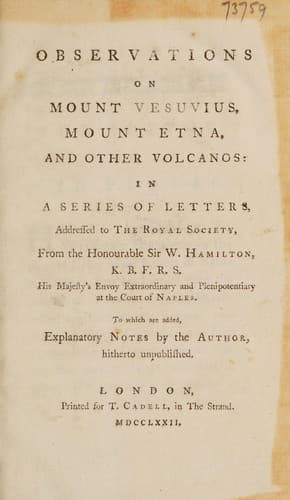
Observations on Mount Vesuvius, Mount Etna, and Other VolcanosHamilton, William, Sir
Science
Observations on Mount Vesuvius, Mount Etna, and Other Volcanos
Hamilton, William, Sir
Etna, Mount (Italy) -- Early works to 1800; Vesuvius (Italy) -- Early works to 1800; Volcanoes -- Italy -- Early works to 1800
the subject of Etna, to shew the quantity of matter thrown up in one
single eruption, by that terrible Volcano. Another proof, that the real
seat of the fire of Volcanos lies even greatly below the general level
of the country whence the mountain springs, is, that was it only at an
inconsiderable depth below the basis of the mountain, the quantity of
matter thrown up would soon leave so great a void immediately under it,
that the mountain itself must undoubtedly sink and disappear after a few
eruptions.
In the above accounts of the formation of the new mountain, we are told
that the matter first thrown up, was mud composed of water and ashes,
mixed with pumice stones and other burnt matter: on the road leading
from Puzzole to Cuma, part of the cone of this mountain has been cut
away, to widen the road. I have there seen that its composition is a
_tufa_ intermixed with pumice, some of which are really of the size of
an ox, as mentioned in Toledo's account, and exactly of the same nature
as the _tufa_ of which every other high ground in its neighbourhood is
composed; similar also to that which covers Herculaneum. According to
the above accounts, after the muddy shower ceased, it rained dry ashes:
this circumstance will account for the strata of loose pumice and ashes,
that are generally upon the surface of all the _tufas_ in this country,
and which were most probably thrown up in the same manner. At the first
opening of the earth, in the plain near Puzzole, both accounts say, that
springs of water burst forth; this water, mixing with the ashes,
certainly occasioned the muddy shower; when the springs were exhausted,
there must naturally have ensued a shower of dry ashes and pumice, of
which we have been likewise assured. I own, I was greatly pleased at
being in this manner enabled to account so well for the formation of
these _tufa_ stones and the veins of dry and loose burnt matter above
them, of which the soil of almost the whole country I am describing is
composed; and I do not know that any one has ever attended to this
circumstance, though I find that many authors, who have described this
country, have suspected that parts of it were formed by explosion.
Wherever then this sort of _tufa_ is found, there is certainly good
authority to suspect its having been formed in the same manner as the
_tufa_ of this new mountain, for, as I said before, Nature is generally
uniform in all her operations.
It is commonly imagined that the new mountain rose out of the Lucrine
lake, which was destroyed by it; but in the above account, no mention is
made of the Lucrine lake; it may be supposed then, that the famous dam,
which Strabo and many other ancient authors mention to have separated
that lake from the sea, had been ruined by time or accident, and that
the lake became a part of the sea before the explosion of 1538.
Public-domain text, read in full here on John Shaqi.
Reviews
Reviews
No reviews yet
Be the first to share your thoughts on this work.
Join the Discussion
Join the discussion
Sign in to leave a comment or review.
Sign InorCreate an account