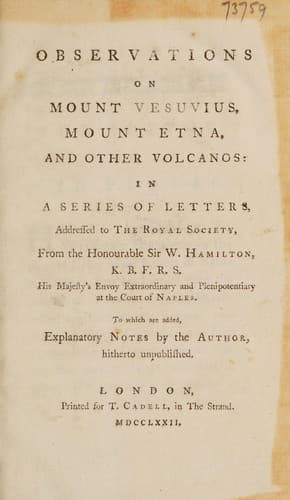
Observations on Mount Vesuvius, Mount Etna, and Other VolcanosHamilton, William, Sir
Science
Observations on Mount Vesuvius, Mount Etna, and Other Volcanos
Hamilton, William, Sir
Etna, Mount (Italy) -- Early works to 1800; Vesuvius (Italy) -- Early works to 1800; Volcanoes -- Italy -- Early works to 1800
If the above-described eruption was terrible, that which formed the
Monte Barbaro (or Gauro, as it was formerly called), must have been
dreadful indeed. It joins immediately to the new mountain, which in
shape and composition it exactly resembles; but it is at least three
times as considerable. Its crater cannot be less than six miles in
circumference; the plain within the crater, one of the most fertile
spots I ever saw, is about four miles in circumference: there is no
entrance to this plain, but one on the East side of the mountain, made
evidently by art; in this section you have an opportunity of seeing that
the matter of which the mountain is composed is exactly similar to that
of the Monte Nuovo. It was this mountain that produced (as some authors
have supposed) the celebrated Falernian wine of the ancients.
Cuma, allowed to have been the most ancient city of Italy, was built on
an eminence, which is likewise composed of _tufa_, and may be naturally
supposed a section of the cone formed by a very ancient explosion.
The lake of Avernus fills the bottom of the crater of a mountain,
undoubtedly produced by explosion, and whose interior and exterior
form, as well as the matter of which it is composed, exactly resemble
the Monte Barbaro and Monte Nuovo. At that part of the basis of this
mountain which is washed by the sea of the bay of Puzzole, the sand is
still very hot, though constantly washed by the waves; and into the cone
of the mountain, near this hot sand, a narrow passage of about 100 paces
in length is cut, and leads to a fountain of boiling water, which,
though brackish, boils fish and flesh without giving them any bad taste
or quality, as I have experienced more than once. This place is called
Nero's bath, and is still made use of for a sudatory, as it was by the
ancients; the steam that rises from the hot fountain abovementioned,
confined in the narrow subterraneous passage, soon produces a violent
perspiration upon the patient who sits therein. This bath is reckoned a
great specifick in that distemper which is supposed to have made its
appearance at Naples before it spread its contagion over the other
parts of Europe.
Public-domain text, read in full here on John Shaqi.
Reviews
Reviews
No reviews yet
Be the first to share your thoughts on this work.
Join the Discussion
Join the discussion
Sign in to leave a comment or review.
Sign InorCreate an account