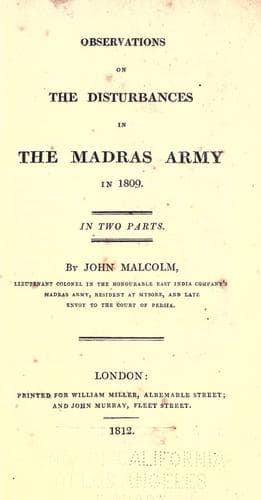
Observations on the Disturbances in the Madras Army in 1809Malcolm, John
History
Observations on the Disturbances in the Madras Army in 1809
Malcolm, John
India. Army -- History; Malcolm, John, 1769-1833
principle will effect more in the cause of authority than its rigid
observance; when lenity is more powerful than severity, and mildness
and moderation tend more to restore order and to maintain tranquillity,
than all the force of a violent government.
The intelligent reader will perceive, that, in contrasting free and
despotic governments, I refer exclusively to rules of administration.
Laws are, no doubt, more inflexible in free states than in others. But
even respecting laws it may be observed, that the general principle
prevails: for the legislative power in free states shows a disposition
to repeal or modify laws in reference to the interests, the opinions,
sometimes even to the prejudices, of great bodies of the people;
while the despot has no maxim, but that all must be subject to the
authority of Government. There is, no doubt, a great distinction in
every community between civil and military bodies: the laws for the
government of the latter are, of course, more arbitrary and unbending;
but, even in these bodies there is a _national character_ that will
compel attention. The same principles cannot be applied to an English
as a Russian army: and it is when such bodies are in an agitated and
convulsed state, that these characteristic distinctions are most
prominent and discernible. It is on such emergencies that a statesman
will succeed in averting a danger, which will only be increased by
every measure of the mere rote follower of public rules. Cicero[2]
has observed, that "it appears to be the dictate of sound policy, to
act in accommodation to particular conjunctures, and not obstinately
persevere in one invariable scheme, when the public circumstances,
together with the sentiments of the best and wisest members of the
community, are evidently changed. In conformity to this notion, the
most judicious reasoners on the art of government have universally
condemned an inflexible perseverance in one uniform tenor of measures.
The skill of the pilot is shown in weathering the storm at least,
though he should not gain his port." Public merit (agreeable to
the extended view of that great orator and statesman, as expressed
afterwards) consists in "having been inflexible in our intentions for
the public welfare, and not by a positive perseverance in certain
favourite modes of obtaining it."
Public-domain text, read in full here on John Shaqi.
Reviews
Reviews
No reviews yet
Be the first to share your thoughts on this work.
Join the Discussion
Join the discussion
Sign in to leave a comment or review.
Sign InorCreate an account