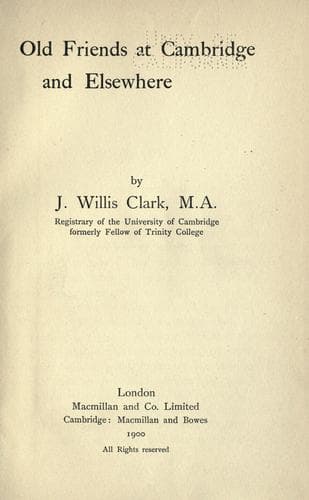
Old Friends at Cambridge and Elsewhere — John Shaqi
Old Friends at Cambridge and ElsewhereClark, John Willis
History
Old Friends at Cambridge and Elsewhere
Clark, John Willis
University of Cambridge -- History
preferring the “Paradiso” to the two preceding parts, an opinion in
which I thoroughly agree[35].
‘As Mr Thirlwall can speak French sufficiently well to make himself
understood, and as he has _something to say_, Charles found it very
practicable to make him and Professor Bekker acquainted, though
Professor Bekker has usually the great defect of _never_ speaking but
when he is prompted by his own inclination, and of never being _inclined
to speak_ except to persons whom he has long known—that is, to whose
faces and manners he has become accustomed, and whose understanding or
character he respects or likes.... In conclusion, I must say about Mr
Thirlwall, that I was prepossessed in his favour by his having made up
in a marked manner to Charles, rather than to myself. I had no
difficulty in getting on with him, but I had all the advances to make;
and I can never think the worse of a young man, just fresh from college
and unused to the society of women, for not being at his ease with them
at first[36].’
It is vexatious that Thirlwall’s biographers should have failed to
discover—if indeed they tried to discover—any information about his
Roman visit, to which he always looked back with delight, occasioned as
much by the friends he had made there as by ‘the memorable scenes and
objects’ he had visited[37]. So far as we know, the above letter is the
only authority extant. We should like to have heard whether Thirlwall
had, or had not, any personal intercourse with Niebuhr, whom we have
reason to believe he never met; and to what extent Bunsen influenced his
future studies. We find it stated in Bunsen’s life that he determined
Thirlwall’s wavering resolutions in favour of the clerical
profession[38]. This, as we shall presently shew, is clearly a mistake;
but, when we consider the strong theological bias of Bunsen’s own mind,
it does seem probable that he would direct his attention to the modern
school of German divinity. We suspect that Thirlwall had been already
influenced in this direction by the example, if not by the direct
precepts, of Herbert Marsh, then Lady Margaret’s Professor of Theology
at Cambridge[39], who had stirred up a great controversy by translating
Michaelis’ _Introduction to the New Testament_, and by promoting a more
free criticism of the Gospels than had hitherto been thought
permissible. However this may be, it is certain that the friendship
which began in Rome was one of the strongest and most abiding influences
which shaped Thirlwall’s character, and just half a century afterwards
we find him referring to Bunsen as a sort of oracle in much the same
language that Dr Arnold was fond of employing.
Public-domain text, read in full here on John Shaqi.
Reviews
Reviews
No reviews yet
Be the first to share your thoughts on this work.
Join the Discussion
Join the discussion
Sign in to leave a comment or review.
Sign InorCreate an account