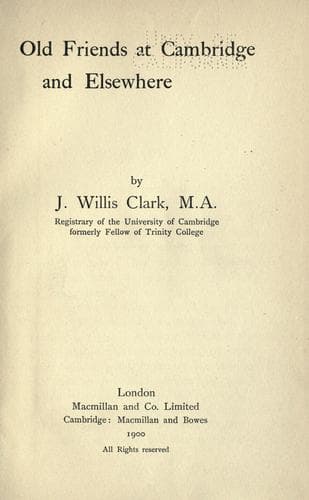
Old Friends at Cambridge and Elsewhere — John Shaqi
Old Friends at Cambridge and ElsewhereClark, John Willis
History
Old Friends at Cambridge and Elsewhere
Clark, John Willis
University of Cambridge -- History
We must pass lightly and rapidly over the next seven years of
Thirlwall’s life. He entered as a law student at Lincoln’s Inn in
February 1820, and in 1827 returned to Cambridge. In the intervening
period he had given the law a fair trial; but the more he saw of it the
less he liked it. It is painful to think of the weary hours spent over
work of which he could say, four years after he had entered upon it, ‘It
can never be anything but loathsome to me[40]’; ‘my aversion to the law
has not increased, as it scarcely could, from the first day of my
initiation into its mysteries’; or to read his pathetic utterances to
Bunsen, describing his wretchedness, and the delight he took in his
brief excursions out of law into literature, consoling himself with the
reflection that perhaps he gained in intensity of enjoyment what he lost
in duration. With these feelings it would have been useless for him to
persevere; but we doubt if the time spent in legal work was so entirely
thrown away as he imagined. It might be argued that much of his future
eminence as a bishop was due to his legal training. As a friend has
remarked, ‘he carried the temper, and perhaps the habit, of Equity into
all his subsequent work’; and to the end of his life he found a special
delight in tracking the course of the more prominent _causes célèbres_
of the day, and expressing his judgment upon them[41]. Even in these
years, however, law was not allowed to engross his whole time. From the
beginning he had laid this down as a fixed principle. He spent his
vacations in foreign travel, and every moment he could snatch from his
enforced studies was devoted to a varied course of reading, of which the
main outcome was a translation of Schleiermacher’s _Critical Essay on
the Gospel of S. Luke_[42], to which his friend Hare had introduced him.
Why should Thirlwall have selected, as a specimen of the new school of
German theology, a work which, at this distance of time, does not appear
to be specially distinguished for merit or originality[43]? It is
evident, from what he says in his _Introduction_, that he had a sincere
admiration for the talents of Dr Schleiermacher, whom he describes as
‘this extraordinary writer,’ whose fate it has been ‘to open a new path
in every field of literature he has entered, and to tread all alone.’
But the real motive for the selection is to be found, we think, in the
opportunity it afforded him for studying the whole question of the
origin and authorship of the synoptic Gospels, and, as the title page
informs us, for dealing with the contributions to the literature of the
subject which had appeared since Bishop Marsh’s _Dissertation on the
Origin and Composition of our three first Canonical Gospels_, published
in 1801. In this direct reference to Marsh’s work we find a confirmation
of our theory that Thirlwall owed to him his position as a critical
theologian, though we can hardly imagine a greater difference than that
Public-domain text, read in full here on John Shaqi.
Reviews
Reviews
No reviews yet
Be the first to share your thoughts on this work.
Join the Discussion
Join the discussion
Sign in to leave a comment or review.
Sign InorCreate an account