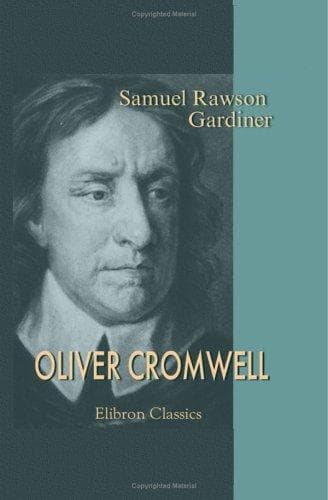
Cromwell, Oliver, 1599-1658; Great Britain -- History -- Commonwealth and Protectorate, 1649-1660
Cromwell's reply did not even pretend to meet the difficulty. It
was not in him to forecast the prospects of kingship in England, or
to vex his mind with the consequences of a problematical Royalist
victory. It was enough for him to grasp the actual situation. It is
true that, at this time, he had not got beyond the position from which
the whole of the Parliamentary party had started at the beginning of
the war--the position that the war must be ended by a compact between
King and Parliament. To Cromwell, therefore, whose heart was set upon
the liberation of those who in his eyes were the people of God, and the
overthrow of ceremonial observances, the immediate duty of the moment
was to secure that, when the time of negotiation arrived, the right
side should be in possession of sufficient military force to enable it
to dictate the terms of peace. It was his part not to consider what the
King might do if he proved victorious, but to take good care that he
was signally defeated. Strange to say, the folly of the Presbyterian
party--strong in the two Houses, and in the support of the Scottish
army--was playing into Cromwell's hands. On November 20, ten days
after Cromwell's altercations with Manchester, Parliament sent to
Oxford terms of peace so harsh as to place their acceptance outside the
bounds of possibility. The royal power was to be reduced to a cipher,
whilst such a form of religion as might be agreed upon by the Houses
in accordance with the Covenant was to be imposed on all Englishmen,
without toleration either for the sects favoured by Cromwell, or for
the Church of Andrewes and Laud which found one of its warmest and most
conscientious supporters in Charles. Every man in the three kingdoms,
including the King himself, was to be bound to swear to the observance
of the Covenant. Such a demand naturally met with stern resistance.
"There are three things," replied Charles, "I will not part with--the
Church, my crown, and my friends; and you will have much ado to get
them from me." It needed no action on the part of Cromwell to secure
the failure of such a negotiation, and, so far as we are aware, no word
passed his lips in public on the subject.
Public-domain text, read in full here on John Shaqi.
Reviews
Reviews
No reviews yet
Be the first to share your thoughts on this work.
Join the Discussion
Join the discussion
Sign in to leave a comment or review.
Sign InorCreate an account