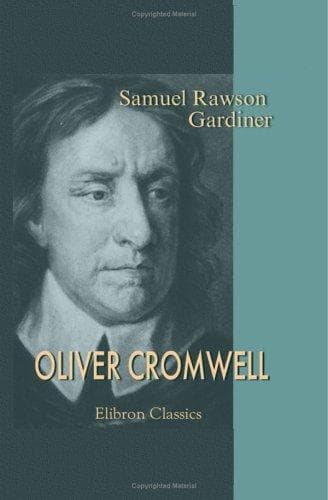
Cromwell, Oliver, 1599-1658; Great Britain -- History -- Commonwealth and Protectorate, 1649-1660
One piece of evidence has indeed been put forward against Cromwell. On
the register of St. John's parish at Huntingdon are two entries--one
dated 1621, and the other 1628--stating that Cromwell submitted in
those years to some form of Church censure. The formation of the
letters, however, the absence of any date of month or day, and also the
state of the parchment on which the entries occur, leave no reasonable
doubt that they were the work of a forger. It does not follow that the
forger had not a recollection that something of the kind had happened
within local memory, and if we take it as possible that Cromwell was
censured for 'his deeds,' whatever they may have been, in 1621, and
that in 1628 he voluntarily acknowledged some offence--the wording
of the forged entry gives some countenance to this deduction--may we
not note a coincidence of date between the second entry and one in
the diary of Sir Theodore Mayerne--the fashionable physician of the
day--who notes that Oliver Cromwell, who visited him in September of
that year, was _valde melancholicus_. Even if no heed whatever is to
be paid to the St. John's register, Mayerne's statement enables us
approximately to date that time of mental struggle which he passed
through at some time in these years, and which was at last brought
to an end when the contemplation of his own unworthiness yielded to
the assurance of his Saviour's love. "Whoever yet," he wrote long
afterwards to his daughter Bridget, "tasted that the Lord is gracious,
without some sense of self, vanity and badness?" It was a crisis in his
life which, if he had been born in the Roman communion, would probably
have sent him--as it sent Luther--into a monastery. Being what he was,
a Puritan Englishman, it left him with strong resolution to do his work
in this world strenuously, and to help others in things temporal, as he
himself had been helped in things spiritual.
English Puritanism, like other widely spread influences, was complex
in its nature, leading to different results in different men.
Intellectually it was based on the Calvinistic theology, and many were
led on by it to the fiercest intolerance of all systems of thought
and practice which were unconformable thereto. Cromwell's nature
was too large, and his character too strong, to allow him long to
associate himself with the bigots of his age. His Puritanism--if not as
universally sympathetic as a modern philosopher might wish--was moral
rather than intellectual. No doubt it rendered him impatient of the
outward forms in which the religious devotion of such contemporaries
as George Herbert and Crashaw found appropriate sustenance, but at
the same time it held him back from bowing down to the idol of the
men of his own party--the requirement of accurate conformity to the
Calvinistic standard of belief. It was sufficient for him, if he and
his associates found inspiration in a sense of personal dependence on
God, issuing forth in good and beneficent deeds.
Public-domain text, read in full here on John Shaqi.
Reviews
Reviews
No reviews yet
Be the first to share your thoughts on this work.
Join the Discussion
Join the discussion
Sign in to leave a comment or review.
Sign InorCreate an account