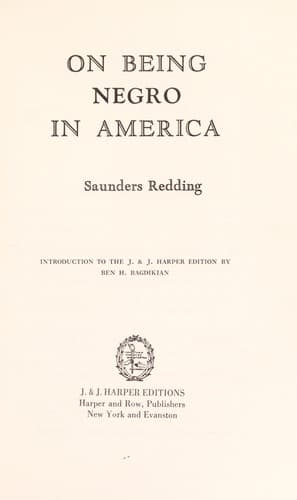
On Being Negro in AmericaRedding, J. Saunders (Jay Saunders)
General
On Being Negro in America
Redding, J. Saunders (Jay Saunders)
African Americans -- Race identity; Redding, J. Saunders (Jay Saunders), 1906-1988; United States -- Race relations
I knew what she meant. She could no longer be arrested in ethnocentric
coils: she did not wish to be. The human spirit is bigger than that.
The specialization of the senses and talent and learning (more than
three fourths of the Negro Ph.D.’s have done their doctoral
dissertations on some subject pertaining to the Negro!) that is expected
of Negroes by other members of their race and by whites is tragic and
vicious and divisive. I am tired of trying, in deference to this
expectation, to feel my way into the particularities of response and
reaction that are supposed to be exclusively “Negro.” I am tired of the
unnatural obligation of converting such talent and learning as I have
into specialized instruments for the promotion of a false concept called
“race.” This extended essay, then, is probably my last public comment on
the so-called American race problem.
5
Names have been given to the advocates and promoters of various racial
policies. There are gradualists (and they are black and white), who feel
that somehow by a process of mechanical progression everything will work
out, though to what concrete ends they do not say. The race chauvinists
advocate a self-sustaining Negro economic, social and cultural island,
and seem to have no fear of a destructive typhoon roaring in from the
surrounding sea of the white world. The educationists believe that
intellectual competence as indicated by the number of Negro Phi Beta
Kappas, doctors of philosophy and various experts will win for the race
the respect it does not now receive. There are the individualists who
urge that each man work out for himself the compromises that will bring
the self-fulfillment he seeks. Finally there are the radicals (there are
no degrees of radicalism among them) who, because they seem to see
destruction as an end and would first uproot everything, are actually
nihilists.
Various racial and biracial institutions look on themselves as
representing and implementing one or the other of these policies. The
Southern Regional Council, for instance, is gradualist. The Negro press
is chauvinist. Most Negro Greek-letter organizations (of which there are
seven national and many dozen sectional and local) are educationist.
Howard University—though not its president—and the best-known private
Negro colleges are individualistic in their approach. Until its demise,
the National Negro Congress was radical.
Public-domain text, read in full here on John Shaqi.
Reviews
Reviews
No reviews yet
Be the first to share your thoughts on this work.
Join the Discussion
Join the discussion
Sign in to leave a comment or review.
Sign InorCreate an account