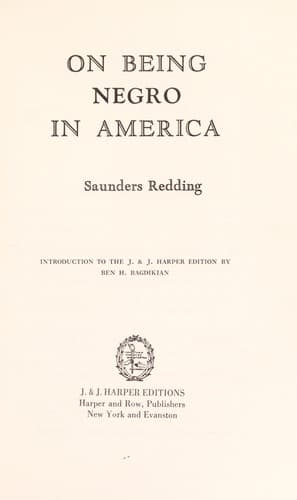
On Being Negro in AmericaRedding, J. Saunders (Jay Saunders)
General
On Being Negro in America
Redding, J. Saunders (Jay Saunders)
African Americans -- Race identity; Redding, J. Saunders (Jay Saunders), 1906-1988; United States -- Race relations
But none of these is seamless, pure and undefiled. Into each of them
have seeped influences from one or more of the others. In so far as the
Southern Regional Council believes in segregation (and that is very far
indeed), it is chauvinistic, and in as much as it sets a premium on
intellectual growth as measured by scholarly achievement, it is also
educationistic. By the very circumstances of their founding, private
Negro colleges lean toward chauvinism, and they encourage this tendency
further by courses in “Negro” history, art, literature, business and
life. Recently, moreover, some Negro colleges have spoken in favor of
the South’s segregated regional education plan—the private ones for
reasons not quite clear; the public ones because only segregation will
save them from extinction. The radicals who, anyway, take the position
that radicalism is the highest, brightest star in the ideological
heavens, are very proud of the intellectual caliber of Paul Robeson, Ben
Davis, and that other Davis, John, erstwhile president of the National
Negro Congress. The Negro press, of course, reflects these conflicts and
inconsistencies.
But something more fundamental than the contradictions accounts for
the failures of these policies. Gradualism, a habit of thought that
marks interracial activities in the South, is geared to the
historic-compulsion idea mentioned earlier. It is mostly faith without
works, thunder without God, and lengthy, frequently fraudulent reports
of “victories” as represented in the decline of lynching and the “long
step forward” (nearly a generation in the taking) from the Holcutt
case (1932) to the Sweatt case (1950).[4] As a principle, gradualism
is very flattering to the Negro people. It ascribes to them superhuman
patience, fortitude and humility in the face of very great social
evils. Gradualism is _laissez faire_—a proscription of planning and
foresight in the dynamics of society.
Chauvinism is as impractical for the Negro in America as it is
fundamentally dangerous for any people anywhere. Even if Negroes could
duplicate the social and economic machinery—and I doubt that they
could—the material resources on which their racial island must then
depend would have to come from somewhere outside. In a constantly
shrinking world, complete independence and isolation are impossible. And
even if they were not impossible for the Negro in America, would not the
achieving of them result in permanent relegation to secondary status?
The very numbers involved—that is, the population ratio—would assure it.
I cannot imagine the white majority saying, “Sure, come on and set up
your self-sustaining household in a corner of my house.”
Public-domain text, read in full here on John Shaqi.
Reviews
Reviews
No reviews yet
Be the first to share your thoughts on this work.
Join the Discussion
Join the discussion
Sign in to leave a comment or review.
Sign InorCreate an account