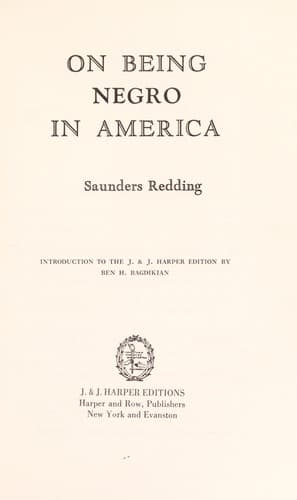
On Being Negro in AmericaRedding, J. Saunders (Jay Saunders)
General
On Being Negro in America
Redding, J. Saunders (Jay Saunders)
African Americans -- Race identity; Redding, J. Saunders (Jay Saunders), 1906-1988; United States -- Race relations
Many Negroes will deny that the force which I have described as daemonic
has operated in their lives. If asked about it, they will take quick
offense, as if it were of the same stripe as an unnatural sex drive
which, of course, is wisely kept secret by those who possess it. They
will aver that they live _normal_, _natural_, _wholesome_ lives, even in
the South. They will point out their “normal” interests in their
professional lives and in their home lives. They will tick off the list
of their white friends. They will say, truthfully enough, “Oh, there are
ways to avoid prejudice and segregation.” I have no quarrel with them
(nor with any others): it is simply that I do not believe them. Having
to avoid prejudice and segregation is itself unwholesome, and the
constant doing of it is skating very close to a psychopathic edge. My
experience has been that no two or three Negroes ever come together for
anything—even so unracial a thing as, say, a Christmas party—but that
the principal subject of conversation is race. One grows mortally sick
of it.
So in a sense, partly through the writing of this essay, I seek a purge,
a catharsis, wholeness—as all of us do perhaps unconsciously in one way
or another. I do this consciously, feeling that I owe it to myself. I
need to do it for spiritual reasons, as others need to seek God. Indeed,
this is a kind of god-seeking, or at least an exorcism. To observe one’s
own feelings, fears, doubts, ambitions, hates; to understand their
beginnings and weigh them is to control them and to destroy their
dominance. By setting certain things down, I hope to get rid of
something that is unhealthy in me (that is perhaps unhealthy in most
Americans) and so face the future with some tranquillity.
Also, and finally, I hope this piece will stand as the epilogue to
whatever contribution I have made to the “literature of race.” I want to
get on to other things. I do not know whether I can make this clear, but
the obligations imposed by race on the average educated or talented
Negro (if this sounds immodest, it must) are vast and become at last
onerous. I am tired of giving up my creative initiative to these
demands. I think I am not alone. I once heard a world-famous singer say
that as beautiful as the spirituals are and as great a challenge as they
present to her artistry, she was weary of the obligation of finding a
place for them in every program, “as if they were theme music” wholly
identifying her. She was tired of trying to promote in others and of
keeping alive in herself a race pride that had become disingenuous and
peculiar. The spirituals belong to the world, she said, and “yet I’m
expected to sing them as if they belong only to me and other Negroes and
as if I believe my talent is most rewardingly and truly fulfilled in
singing them, and I just don’t think it necessarily is.” As a matter of
fact, she added, she was having more and more trouble _feeling_ her way
into them.
Public-domain text, read in full here on John Shaqi.
Reviews
Reviews
No reviews yet
Be the first to share your thoughts on this work.
Join the Discussion
Join the discussion
Sign in to leave a comment or review.
Sign InorCreate an account