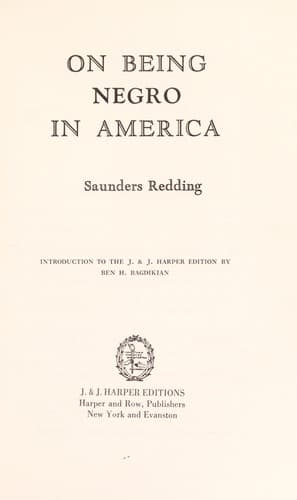
On Being Negro in AmericaRedding, J. Saunders (Jay Saunders)
General
On Being Negro in America
Redding, J. Saunders (Jay Saunders)
African Americans -- Race identity; Redding, J. Saunders (Jay Saunders), 1906-1988; United States -- Race relations
There is still a great deal of race chauvinism, and the fact should
surprise no one. Negro organs of expression, including scholarly
journals, document it: _Phylon: [A] Review of Race & Culture_, published
by Atlanta University; the _Journal of Negro Education_, published by
Howard University; the _Journal of Negro Higher Education_, published by
Johnson C. Smith University; the _Journal of Negro History_, published
by the Association for the Study of Negro Life and History; and a spate
of lesser publications. A purely emotional conviction informs
chauvinism. It is partly the frustrated pride that is expressed in
“Negro History Week” observances, which dichotomize United States
history, and in courses in “Negro” literature and art, which turn out to
be valiant but thin trickles forcibly and ingenuously diverted from the
main stream of American life. Chauvinism springs from a natural desire
to find remission from the unequal struggle between black and white, and
surcease of discrimination.
The philosophy of the educationist is only superficially different from
that of the individualist. The concepts in which they are hallowed seem
only to obscure the fact that no man is completely the master of his
fate. Only the immature fail to recognize that individual wishes now
have almost no authority in the world. Educationists and individualists
acknowledge the existence of co-operative evils but deny the necessity
to act co-operatively against them. This is also, it seems to me, a
denial of brotherhood—a principle which must be made to operate in
increasingly wider and wider arcs of human endeavor. Any statement of
the individualist’s ideals would sound like a throwback to the time
before theories of social compact, or better, social contract, evolved.
The contradictions and conflicts in all this go deeper, much deeper than
any short and general analysis can indicate. They plunge their iron
tentacles into the minds of individual Negroes, raggedly fragmenting
them, scoring them into oversensitized compartments. It is this that we
must understand when we think, for instance, of Paul Robeson; and when
we hear a Negro college president declare himself opposed to
segregation, while at the same time he urges the state to add graduate
courses to his already substandard curriculum, so that Negro aspirants
to graduate degrees will not embarrass the state’s white university; and
when we read on page one of a Negro paper a vilification of white women
who “run after” Negro men and on the next page an encomium of a
successful mixed marriage. This is more than simply resiliency and
accommodation, and there is more than just Negro heart and mind
involved. For the Negro is not _the_ problem _in toto_, nor a problem
_in vacuo_. His behavior, the patterns of his multiple personality, the
ebb and flow of action and counteraction and the agonizing ruptures in
his group life result from the ill-usage to which he is subject at the
hands of American white people.
Public-domain text, read in full here on John Shaqi.
Reviews
Reviews
No reviews yet
Be the first to share your thoughts on this work.
Join the Discussion
Join the discussion
Sign in to leave a comment or review.
Sign InorCreate an account