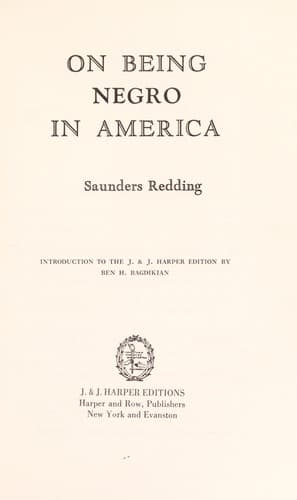
On Being Negro in AmericaRedding, J. Saunders (Jay Saunders)
General
On Being Negro in America
Redding, J. Saunders (Jay Saunders)
African Americans -- Race identity; Redding, J. Saunders (Jay Saunders), 1906-1988; United States -- Race relations
6
Looking back now, I know that the essence of these conflicts was
distilled in my own boyhood home. My mother, who certainly would not
have phrased it so, or even consciously thought it so, was an
individualist. She was also the perfect embodiment of a type of Negro
womanhood whose existence is still denied by those who cling to the old
abasing habits of thought. Virtuous, educated and noted for her beauty,
she lived her short life in a firm belief that the moral exercise of
individual initiative, imagination and will was enough to overcome the
handicap of a colored skin. I have before me now some lines she wrote,
obviously thinking of her sons.
And so you are a son of darker hue!
Think then that God sees in your face
A lesser image of his love and grace—
The ills of life all meant for you?
What light before you beckoning?
The iron will, the open heart and mind,
The hope, the wish, the thought refined—
These compass points for a true reckoning.
These are not a full expression of her thought, for there was enough of
the chauvinist and enough of the sense of reality in her to make it
clear that in her time, except in the most unusual circumstances, the
limits of progress for the Negro were within the Negro world. Yet she
spoke with pensive pride of Howard Drew, who had been a great college
athlete and who was then a Hartford lawyer with an entirely white
clientele; and of Maria Baldwin, the Negro principal of the very
estimable Agassiz School in Cambridge, where many Harvard professors
sent their children; and of Lillian Evans (Madame Evanti), who sang
opera for a season at La Scala; and even (though with less pride, for
the theater was still suspect in her mind) of Bert Williams.
But my father was different. He took pride in such successes too, but it
irritated him that the knowledge of them was not more widespread. He
would have used them on the one hand as arguments against the
white-superiority theories of Lothrop Stoddard, Madison Grant and Jerome
Dowd, and on the other, as arguments for his own theory that the Negro
could and should develop his own American culture. I saw him brought to
the verge of tears when the Brown and Stevens Bank—“the richest and
safest Negro bank in the world”—failed back in the early 1920’s. And
this was not because he lost money in that disastrous collapse—he
didn’t—but because that failure cast dark shadows over the prospects of
a self-sustaining Negro culture. He saw other shadows many times, but he
remained (and now in his eighty-second year remains still in his heart,
I think) a race chauvinist. For him there was no incongruity between
this and his insistence that his sons go East to a New England college.
Public-domain text, read in full here on John Shaqi.
Reviews
Reviews
No reviews yet
Be the first to share your thoughts on this work.
Join the Discussion
Join the discussion
Sign in to leave a comment or review.
Sign InorCreate an account