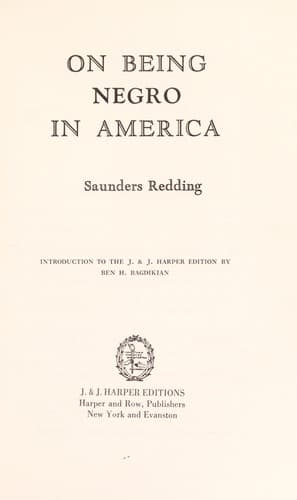
On Being Negro in AmericaRedding, J. Saunders (Jay Saunders)
General
On Being Negro in America
Redding, J. Saunders (Jay Saunders)
African Americans -- Race identity; Redding, J. Saunders (Jay Saunders), 1906-1988; United States -- Race relations
Through all the years of my boyhood, my father was secretary of the
Wilmington, Delaware, branch of the National Association for the
Advancement of Colored People; secretary-treasurer of the Sara Ann White
Home (now the Layton Home) for Aged Colored People; and a member of the
board of the local Negro Y.M.C.A., which he helped found. Besides, he
had certain pet, private projects, like needling the truant officer for
not making colored children go to school, and upbraiding the police for
permitting (interracial) vice to flourish in some Negro neighborhoods,
and scolding fallen Negro women and derelict Negro men wherever he found
them. He was buoyant and earnest and uplifted in the prosecution of
these activities. What characters were drawn to our house! How desperate
they were (I know now) in their search for simplification and for that
dignity of being that derives only from a sense of belonging!
For these—simplicity and dignity—after all are the true things for which
men strive. Unable to attain them in the large sense, men slice life up
into manipulatable segments, institute policies of control, reduce to
some petty enslaving program and to slogans the great purposes of
life—“America for Americans,” “For the Advancement of Colored People,”
“The True Church”—and march uneasily toward their graves under the
illusion that the particular distortion into which they have been drawn
is the straight and narrow path to salvation.
My father was like that. I think that all the Negroes I knew in my
childhood were like that. It was not altogether their fault. It need not
be pointed out that they had almost no say in determining the basic
conditions under which they lived, and that it was this common suffering
that drew them together in the first place. But subject to the common
suffering was no mass man, but classes and individuals, and what they
endured together they examined separately in the powerful lights of
personal and class interests and ambitions. And under these lights the
caste principle, which white society insisted on and to which the
Negroes were responding in the first place—under these lights, the caste
principle broke down. Negroness was not itself enough. The phrase,
“We’re all Negroes together,” so often heard as a battle cry, had only a
sporadic potency. Within the Negro group there were bitter conflicts and
grave contradictions.
Public-domain text, read in full here on John Shaqi.
Reviews
Reviews
No reviews yet
Be the first to share your thoughts on this work.
Join the Discussion
Join the discussion
Sign in to leave a comment or review.
Sign InorCreate an account