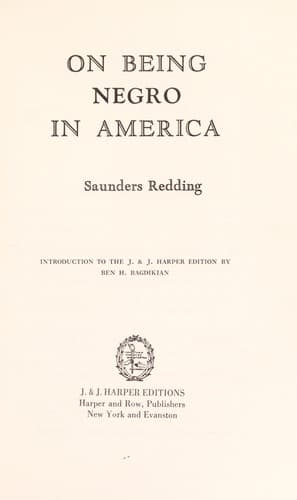
On Being Negro in AmericaRedding, J. Saunders (Jay Saunders)
General
On Being Negro in America
Redding, J. Saunders (Jay Saunders)
African Americans -- Race identity; Redding, J. Saunders (Jay Saunders), 1906-1988; United States -- Race relations
I remember when the tidal wave of Garveyism[5] swept over the walls my
father had been hastily building against it. He had not had much
warning. As secretary of the Wilmington, Delaware, N.A.A.C.P., he
read—nay, studied—the _Crisis_, the Association’s national organ. He
knew the official line was that Marcus Garvey was a mountebank and his
outfit swindlers preying on the poverty and ignorance of the lower
classes. “Do not,” the _Crisis_ said, “invest in the conquest of Africa.
Do not take desperate chances in flighty dreams.” My father knew also,
with increasing disquiet, how fast the Garvey following was growing. But
somehow he felt that only people of the slums _could_ be attracted to
it, and he did not think of Wilmington as having a real slum. Of course
he was naïf in this, for a stone’s throw east of our house began a
noisome squalor of existence that spread like thick slime to the river.
When a sturdy, hard-working citizen (respected because he was
hard-working and kept his children in school and did not let his
insurance lapse) came bringing my father an official invitation to join
the Garveyite “line of march,” my father issued an urgent call to the
members of the N.A.A.C.P. for a meeting.
But it was too late, for suddenly the Garveyites were upon us. They came
with much shouting and blare of bugles and a forest of flags—a black
star centered in a red field. They made speeches in the vacant lot where
carnivals used to spread their tents. They had a huge, colorful parade,
and young women, tensely sober of mien and plain even in their uniforms,
distributed millions of streamers bearing the slogan “Back to Africa.”
My father and I stood on the cross street below our house and watched
the parade swagger by. Among the marchers my father spotted more than
one “Advancer” (his term), even their wives and children. They were not
people of the slums. They were men with small struggling
clothes-pressing shops and restaurants, personal servants, and what
Thomas J. Woofter, Jr., calls “black yeomen,” unlearned but percipient.
They had been dependable attendants at meetings promising Negro uplift,
and loyal though perhaps somewhat awed members of the N.A.A.C.P. Some of
them my father had personally recruited, and low groans of dismay
escaped him when he saw them in the line of march. I was a boy, but I
remember. And not so much because of the parade as for what happened
after.
Public-domain text, read in full here on John Shaqi.
Reviews
Reviews
No reviews yet
Be the first to share your thoughts on this work.
Join the Discussion
Join the discussion
Sign in to leave a comment or review.
Sign InorCreate an account