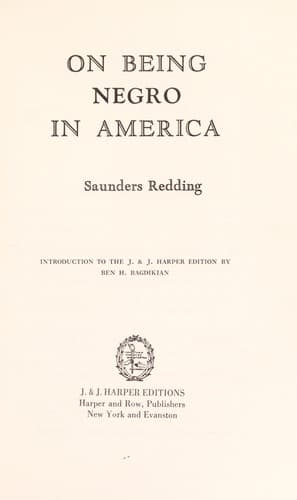
On Being Negro in AmericaRedding, J. Saunders (Jay Saunders)
General
On Being Negro in America
Redding, J. Saunders (Jay Saunders)
African Americans -- Race identity; Redding, J. Saunders (Jay Saunders), 1906-1988; United States -- Race relations
Actually, of course, it is no longer possible to predicate
discrimination and segregation on Negro inferiority. So long as it was
possible and seemed forever possible, the “practical-minded” found a
kind of social justification in disfranchisement, in raising economic
and cultural barriers, in the despotic paternalism which said, “Thou
shalt not.” Even _the_ Negro leader, Booker Washington, found it
blameless and, indeed, good, without ever suspecting that the tradition
of _noblesse oblige_, on which all this was claimed to be founded, might
someday be as ineffective as necromancy. Segregation was order; it was
control; it was the steel and concrete casing sealing up a devastating
social explosion. It still seems so to the vast majority and their
leaders.
The strongest voices in the South today say that segregation must be
kept: Governor James Byrnes in his inaugural was not so intent on
expressing his views on foreign policy that he did not assure his
listeners of his unaltered opposition to the Fair Deal. Hodding Carter,
the liberal mentioned above, is not so liberal that he does not see it
as “tragic for the South, the Negro, and the nation itself” if
segregation is done away with. And “only a fool,” Lillian Smith quotes
from the Atlanta _Constitution_, “would say the Southern pattern of
separation of the races can, or should be overthrown.” But if
segregation must be kept, it must now be predicated on something else
than Negro inferiority.
And what else is there? The cynical ideology of power-worship, what H.
A. Overstreet calls “the fight-and-grab image,” the philosophy of hate.
It is what Hitler came to. It is the result of a pattern of thinking
desperately threatened by science and social change.
8
I am an integrationist. I have been for a long time. It is not a
principle that I arrived at through intellection. Until the past few
years, I did not bring to bear on it whatever intelligence I have. I
felt my way to it, just as some men, in spite of obstructing experience,
feel their way to ideals of honesty, sobriety and continence. Nor was
the feeling of my way wholly conscious. It was rather like the action of
one who kicks and splashes frantically to save himself from drowning and
suddenly finds that he has reached a shelf on which he can stand in the
river bed. His objective was not the shelf, but just to be saved. I
kicked and splashed in all directions, and suddenly there I was.
Public-domain text, read in full here on John Shaqi.
Reviews
Reviews
No reviews yet
Be the first to share your thoughts on this work.
Join the Discussion
Join the discussion
Sign in to leave a comment or review.
Sign InorCreate an account