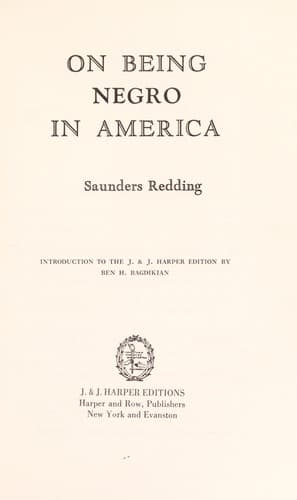
On Being Negro in AmericaRedding, J. Saunders (Jay Saunders)
General
On Being Negro in America
Redding, J. Saunders (Jay Saunders)
African Americans -- Race identity; Redding, J. Saunders (Jay Saunders), 1906-1988; United States -- Race relations
I was an integrationist when the Communists camped almost nightly on my
trail in the early 1930’s and lighted beckoning bright fires in the
frightening dark of that time. I did not believe then (any more than
now) that the moment the bars of segregation are lifted all the white
women of the South will fall into the arms of Negro mates. Many of my
acquaintances gleefully professed to believe this and would just as
gleefully declare that Negroes lynched for rape had been only unlucky in
being caught with their always-willing white paramours. They found
substance for this opinion in both fact and fiction, which too loudly
proclaimed the revulsive feeling of the white female for the Negro and
the inviolable purity of white womanhood. My acquaintances believed that
Southern whites protested too much.
And so, it seems, did the Communists. Or perhaps they did not. It could
have been just a line and the carrying out of explicit directives on
“How to Recruit Negroes in the Eastern States.” It could have been that
they played expertly on what they thought were the secret dreams of a
young, green, mixed-up and lonely man.
I suppose all people suffer from these maladies, and especially from
youth, in early adulthood; but I had more besides. I had a severe case
of “Negrophophilia” which alternately wrenched my heart with hate and
love. I was confused about the direction of my life and extremely
doubtful (as I sometimes am today) of life’s purpose. Whether naturally
or through learning, I shrank from all but a handful of people, and some
of these were a disappointment to me, and I have no doubt that I was a
sore trial to them. I lacked social accommodation. I have never thought
tolerance admirable as a principle either of adjustment or feeling, and
I rejected it entirely for my friends. Dogs were to be tolerated, and
crying babies, and strangers with whom one did not have to become
acquainted. My friends were constantly not living up to my foolish
expectations; my judgments were severe. I was continually breaking with
and rejoining them, but with no increase in understanding.
I do not think I would have become a Communist even had these
deficiencies not been in me. But, certainly, except for them, the
Communists would have had an easier time assailing my weak position on
the extreme left flank of democracy. The wrong scouts came to
reconnoiter, and they took the wrong approach.
Public-domain text, read in full here on John Shaqi.
Reviews
Reviews
No reviews yet
Be the first to share your thoughts on this work.
Join the Discussion
Join the discussion
Sign in to leave a comment or review.
Sign InorCreate an account