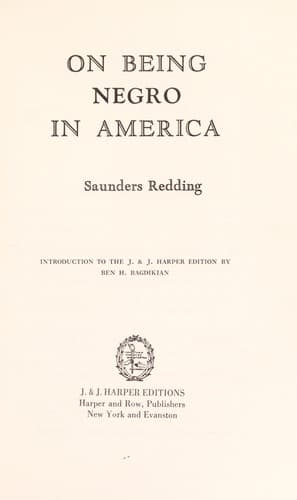
On Being Negro in AmericaRedding, J. Saunders (Jay Saunders)
General
On Being Negro in America
Redding, J. Saunders (Jay Saunders)
African Americans -- Race identity; Redding, J. Saunders (Jay Saunders), 1906-1988; United States -- Race relations
Like the capacity for thought and the desire for knowledge, the
instincts for personal liberty and, within reason, power over one’s
destiny are attributes of the human mind. They are stronger in some than
in others. Where they have been weakened by catastrophe—say
long-continued planned violence, as in war; or widespread social
disorganization, as in times of great economic crises—the instincts can
be perverted, or even totally destroyed. There was danger of this
perversion (which actually developed in some countries in Europe) during
America’s great depression, when the feeling grew that only Franklin D.
Roosevelt had answers and that everything depended on him. The American
people were all but ripe to surrender their minds and the control of
their destiny.
It was the distortion or atrophy of this instinct that the Communists
hoped to find in the American Negro. They had good reason for such
hopes, and they were not loath to express it: “The especially intense
exploitation and heavy oppression to which the millions of Negroes in
America are subject make it imperative for _the Party to devote its best
energies and its maximum resources towards becoming the recognized
leader and champion ... of Negroes_.”[7] (Italics mine.) The intense
exploitation and heavy oppression were true enough. But there was
something that the Communists did not take into account; something
psychical and perhaps unworldly which even the people whom they hoped to
inveigle did not think about. It was not the Negro’s vaunted resiliency,
though this was something. Rather it was what I can think of only as the
spiritual cohesion of democracy. This cohesion is organic to the
delicately balanced ideological structure that democracy is, and it is
the attribute which makes it impossible to separate the destiny of
America from the destiny of democracy itself.
For democracy is less a form of government than it is a way of life, and
the principles—freedom, equality, justice—on which this way of life is
founded have an appeal as universal as the idea of God. And what I am
saying is that in spite of “heavy oppression” and “intense
exploitation,” the American Negro believed in the principles. It was
this belief in the principles and the impossibility of ever dissociating
them in the Negro’s mind from democracy and America that stymied the
Communists, who could not understand why the colored people’s hatred of
discrimination, segregation and all the inequities did not lead
naturally to a hatred of democracy. But it was like expecting them to
hate God because preachers are sometimes rascals.
Public-domain text, read in full here on John Shaqi.
Reviews
Reviews
No reviews yet
Be the first to share your thoughts on this work.
Join the Discussion
Join the discussion
Sign in to leave a comment or review.
Sign InorCreate an account