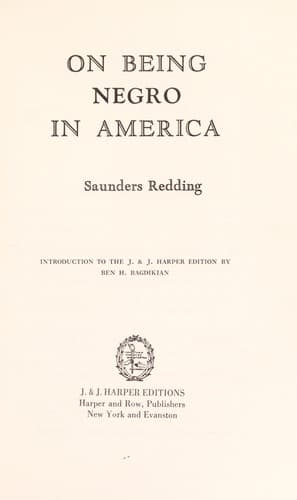
On Being Negro in AmericaRedding, J. Saunders (Jay Saunders)
General
On Being Negro in America
Redding, J. Saunders (Jay Saunders)
African Americans -- Race identity; Redding, J. Saunders (Jay Saunders), 1906-1988; United States -- Race relations
But also integration is in conflict with all that whites as well as
Negroes have been taught to believe. It is in conflict with all that
they think of as making for harmonious social development. Most whites
are convinced that integration is the way to social and even biological
disaster. Conviction is emotional and generally not to be argued with.
If segregationalists could be argued with, they would not be
segregationalists in the first place. They have taken their position on
nonarguable grounds, and I think they have taken it quite contrary to
their _intellectual_ understanding of the problem central to our age.
The Georgia Legislature, in this year 1951, was very sincere when it saw
fit to pass a bill providing that no funds appropriated for education
could go to institutions that did not enforce segregation. Only weeks
later, Governor Byrnes of South Carolina, who has been a Senator, a
Supreme Court Justice and Secretary of State, declared that “The
politicians in Washington and the Negro agitators in North Carolina who
today seek to abolish segregation in all schools will learn that what a
carpetbag government could not do in the Reconstruction Period cannot be
done in this period.” He then proceeded to express the view that before
what “could not be done” would be done, the public-school system in
South Carolina would be abolished.[10]
This is paradox and irony. There is the obvious irony of advocating the
abolishment of the very thing on which democracy must rest—a publicly
schooled citizenry—in order to ensure, as Byrnes implied, the
perpetuation of democracy. But the paradox goes deeper, for if there is
emotionalism in Byrnes’s words, there is also the opposite of
emotionalism. For his words represent a deliberate and a socially
dominant response based on static concepts and ideals—the concept of the
Negro’s inherent inferiority, and the ideal of the white “Anglo-Saxon,”
predominantly Protestant community which earns its right to Divine favor
because it contributes to Negro causes, does not deliberately encourage
the persecution of either Jews or Catholics, and even occasionally
permits itself the hazard of proclaiming the world one.
Public-domain text, read in full here on John Shaqi.
Reviews
Reviews
No reviews yet
Be the first to share your thoughts on this work.
Join the Discussion
Join the discussion
Sign in to leave a comment or review.
Sign InorCreate an account