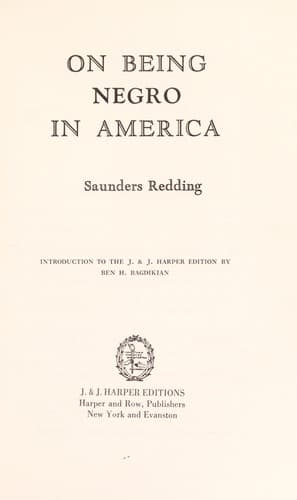
On Being Negro in AmericaRedding, J. Saunders (Jay Saunders)
General
On Being Negro in America
Redding, J. Saunders (Jay Saunders)
African Americans -- Race identity; Redding, J. Saunders (Jay Saunders), 1906-1988; United States -- Race relations
And that thorny prospect brings me to yet another reason for the
personal slant of this essay. I do not wish to live with the race
problem for the next one hundred years—though of course I shall not live
so long. I do not wish to die knowing that my children and theirs to the
third generation must live with it. I have known it too long and too
intimately already. It has itself been an imperative, channelizing more
of my energies than I wished to spare through the narrow gorge of race
interest. Yet I have felt myself in no sense a crusader. I have not been
uplifted with the compensatory afflatus of the inspired leader. Let me
be quite frank. I have done what I have, not because I wanted to, but
because, driven by a daemonic force, I had to. The necessity has always
been a galling affliction to me and the root of my personal grievance
with American life. This should not be hard to understand.
Connected with all this, of course, has been a sense of impersonal
obligation which I like to think of as growing out of a decent regard
for the common welfare. This civic sense has not expressed itself widely
in group and racial activities and organizations, for I am not that kind
of person. If it is a fault, I am sorry for it. I tried to be that kind
of person. At one time or another I have been a member of most of the
racial uplift groups, and am still a member of some, and when I was in
my early twenties I thought I had taken fire from the mass and that if
need be I could exhort and harangue and make public protest with the
best of them. But I did not know myself so well then. What I felt was
merely the exuberant, youthful need for self-losing identification. It
gives me sad amusement to recall that in those days a friend of mine
used teasingly to call me “Marcus Garvey”—a name that was the very
apotheosis of blatant race chauvinism. But I had no real chance to be
blatant—a habit, I suppose, like any other—and no natural inclination.
Nor could I really lose myself in the mass.
3
Public-domain text, read in full here on John Shaqi.
Reviews
Reviews
No reviews yet
Be the first to share your thoughts on this work.
Join the Discussion
Join the discussion
Sign in to leave a comment or review.
Sign InorCreate an account