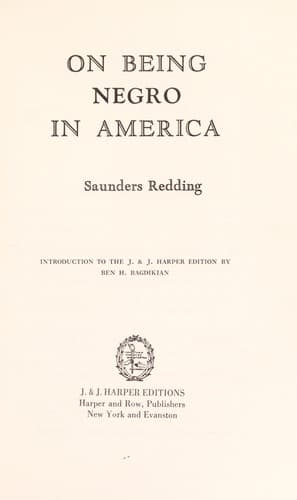
On Being Negro in AmericaRedding, J. Saunders (Jay Saunders)
General
On Being Negro in America
Redding, J. Saunders (Jay Saunders)
African Americans -- Race identity; Redding, J. Saunders (Jay Saunders), 1906-1988; United States -- Race relations
But the years of my twenties were enkindling and tumultuous. The world
was well into that series of social revolutions which started, we are
told, with the First World War and is not yet ended, and the American
Negro people were a kind of revolutionary catalytic agent in their own
country. It was their historic role, to be sure, but it had been
suspended while Negroes played a supernumerary part in the European
conflict. Americans in general seemed not to realize what had happened
in Europe. They did not think of it as change. It was merely an eruption
which they had helped put down and were intent on sealing off with the
cement of isolationism. But after the war American Negroes reenlivened
the spirit of revolt, and the country was alarmed by the truculent
persistence with which they fought for the Dyer Anti-Lynching Bill, for
instance, and by the vigor of their opposition to the confirmation of
Judge John Parker to the United States Supreme Court, and by the inroads
of Communism among them, and by their implacable solidarity in the
Scottsboro case.
How emotional the times were! What comings-together, what incitement!
Out of college just three years at the time of the Scottsboro case in
1931, I remember the almost weekly meetings. Especially do I remember
one at which Alice Dunbar Nelson spoke. The widow of Paul Dunbar, a
Negro poet nationally famous at the turn of the century, Mrs. Nelson had
been one of my teachers in high school and an old family friend. She was
beautiful—tall, with ivory skin and a head of glinting red-gold hair—and
she was also of great and irresistible charm. One thought of her as
being saturated in a serene culture, even in divinity. I doubt that she
had ever been much concerned with the common run of Negroes, and that
night as she spoke to a large audience of all classes of a united
people, she was like a goddess come to earth—but a goddess. In the end,
with tears glistening in her eyes, she stretched out her gloved hands
and cried, “Thank God for the Scottsboro case! It has brought us
together.”
It was a thing to arouse even one constitutionally insensible to mass
excitement, and I was not insensible—not in those days. I had found that
out the year before, my second in the deep South. A student of mine was
murdered, apparently in cold blood, by a white man or men. It happened
in the late afternoon, in a section of Atlanta some distance from the
college, and I knew nothing of it for several hours. But that night a
colleague of about my own age rushed into my dormitory room without the
usual courtesy of knocking.
“Come on,” he said, gesturing vehemently, “we got to go.”
I resented his bursting in on me. We did not particularly care for each
other anyway. “You might have knocked,” I said.
“For Christ’s sake, this is no time for the amenities!” he said. “We got
to go.”
“Go where? I’m not going anywhere.”
“To the meeting.”
“What meeting?”
Public-domain text, read in full here on John Shaqi.
Reviews
Reviews
No reviews yet
Be the first to share your thoughts on this work.
Join the Discussion
Join the discussion
Sign in to leave a comment or review.
Sign InorCreate an account