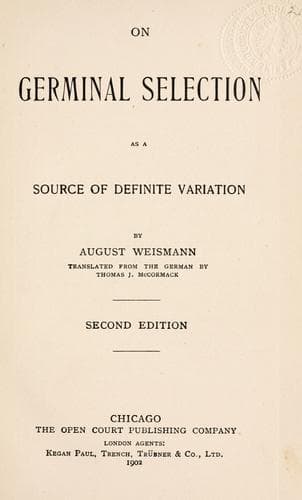
On Germinal Selection as a Source of Definite Variation — John Shaqi
On Germinal Selection as a Source of Definite VariationWeismann, August
Science
On Germinal Selection as a Source of Definite Variation
Weismann, August
Variation (Biology)
For the present I leave out of consideration altogether the question as to
the conceivable extent of the sphere of operation of natural selection; I
am primarily concerned only with elucidating the process of selection
itself, wholly irrespective of the comprehensiveness or limitedness of its
sphere of action. For this purpose it is sufficient to show, as I have just
done, _that cases exist wherein all natural explanations except that of
selection fail us_. But let us now see how far the principle of selection
will carry us in the explanation of such cases--natural selection, I mean,
as it was formulated by Darwin and Wallace.
There can be no doubt but the leaf-markings readily admit of production in
this manner, slowly and with a gradual but constant increase of fidelity,
provided a single condition is fulfilled: _the occurrence of the {26} right
variations at the right place_. But just here, it would seem, is the
insurmountable barrier to the explanatory power of our principle, for who,
or what, is to be our guarantee that dark scales shall appear at the exact
spots on the wing where the midrib of the leaf must grow? And that later
dark scales shall appear at the exact spots to which the midrib must be
prolonged? And that still later such dark spots shall appear at the places
whence the lateral ribs start, and that here also a definite acute angle
shall be accurately preserved, and the mutual distances of the lateral ribs
shall be alike and their courses parallel? And that the prolongation of the
median rib from the hind wing to the fore wing shall be extended exactly to
that spot where the fore wing is not covered by the hind wing in the
attitude of repose? And so on.
If I could go more minutely into this matter, I should attempt to prove
that the markings, as I have just assumed, have not arisen suddenly, but
were perfected very, very gradually; that in one species they began on the
fore wing and in another on the hind wing; and that in many they never
until recently proceeded beyond one wing, in other species they went only a
little way, and in only a few did they spread over the entire surface of
both wings.
That these markings advanced slowly and gradually, but with marvelous
accuracy, is no mere conjecture. But it follows that the right variations
at the right places must never have been wanting, or, as I expressed it
before: _the useful variations were always present_. But how is that
possible in such long extensive lines of dissimilar variations as have
gradually come to constitute markings of the complexity here presented?
Suppose that the useful colors had not {27} appeared at all, or had not
appeared at the right places? It is a fact that in constant species, that
is, in such as are not in process of transformation, the variations of the
markings are by no means frequent or abundant. Or, suppose that they had
really appeared, but occurred only in individuals, or in a small percentage
of individuals?
Public-domain text, read in full here on John Shaqi.
Reviews
Reviews
No reviews yet
Be the first to share your thoughts on this work.
Join the Discussion
Join the discussion
Sign in to leave a comment or review.
Sign InorCreate an account