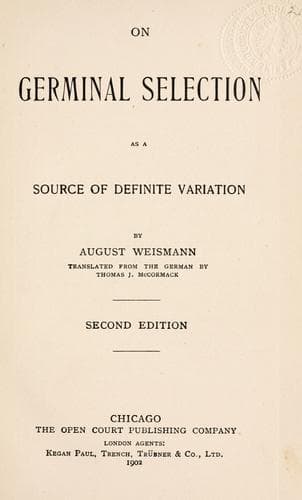
On Germinal Selection as a Source of Definite VariationWeismann, August
Science
On Germinal Selection as a Source of Definite Variation
Weismann, August
Variation (Biology)
It is, therefore, a very remarkable fact, and one deserving of
consideration, that to-day (1895), after science has been in possession of
this principle for something over thirty years and during this time has
steadily and zealously busied itself with its critical elaboration and with
the exact determination of its scope, that now the estimation in which it
is held should apparently be on the decrease. It would be easy to enumerate
a long list of living writers who assign to it a subordinate part only in
evolution, or none at all. One of our youngest biologists speaks without
ado of the "pretensions of the refuted Darwinian theory, so called,"[5] and
one of the oldest and most talented inquirers of our time, a pioneer in the
theory of evolution, who, unfortunately, is now gone to his rest, Thomas
Huxley, implicitly yet distinctly intimated a doubt regarding the principle
of selection when he said: "Even if the Darwinian hypothesis were swept
away, evolution would still stand where it is." Therefore, he, too,
regarded it as not impossible that this hypothesis should disappear from
among {13} the great explanatory principles by which we seek to approach
nearer to the secrets of nature.
I am not of that opinion. I see in the growth of doubts regarding the
principle of selection and in the pronounced and frequently bitter
opposition which it encounters, a transient depression only of the wave of
opinion, in which every scientific theory must descend after having been
exalted, here perhaps with undue swiftness, to the highest pitch of
recognition. It is the natural reaction from its overestimation, which is
now followed by an equally exaggerated underestimation. The principle of
selection was not overrated in the sense of ascribing to it too much
explanatory efficacy, or of extending too far its sphere of operation, but
in the sense that naturalists imagined that they perfectly understood its
ways of working and had a distinct comprehension of its factors, which was
not so. On the contrary, the deeper they penetrated into its workings the
clearer it appeared that something was lacking, that the action of the
principle, though upon the whole clear and representable, yet when
carefully looked into encountered numerous difficulties, which were
formidable, for the reason that we were unsuccessful in tracing out the
actual details of the individual process, and, therefore, in _fixing_ the
phenomenon as it actually occurred. We can state in no single case how
great a variation must be to have selective value, nor how frequently it
must occur to acquire stability. We do not know when and whether a desired
useful variation really occurs, nor on what its appearance depends; and we
have no means of ascertaining the space of time required for the fulfilment
of the selective processes of nature, and hence cannot calculate the exact
number of such {14} processes that do and can take place at the same time
in the same species.
Public-domain text, read in full here on John Shaqi.
Reviews
Reviews
No reviews yet
Be the first to share your thoughts on this work.
Join the Discussion
Join the discussion
Sign in to leave a comment or review.
Sign InorCreate an account