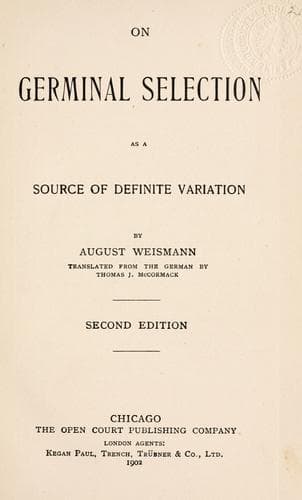
On Germinal Selection as a Source of Definite VariationWeismann, August
Science
On Germinal Selection as a Source of Definite Variation
Weismann, August
Variation (Biology)
Yet all this is necessary if we wish to follow out the
precise details of a given case.
But perhaps the most discouraging circumstance of all is, that in scarcely
a single actual instance in nature can we assert whether an observed
variation is useful or not--a drawback that I distinctly pointed out some
time ago.[6] Nor is there much hope of betterment in this respect, for
think how impossible it would be for us to observe all the individuals of a
species in all their acts of life, be their habitat ever so limited--and to
observe all this with a precision enabling us to say that this or that
variation possessed selective value, that is, was a decisive factor in
determining the existence of the species.
In many cases we can reach at least a probable inference, and say, for
example, that the great fecundity of the frog is a property having
selective value, basing our inference on the observation that in spite of
this fertility the frogs of a given district do not increase.
But even such inferences offer only a modicum of certainty. For who can say
precisely how large this number is? Or whether it is on the increase or on
the decrease? And besides, the exact degree of the fecundity of these
animals is far from being known. Rigorously viewed, we can only say that
great fecundity must be advantageous to a much-persecuted animal.
And thus it is everywhere. Even in the most indubitable cases of
adaptation, as, for instance, in that of the striking protective coloring
of many butterflies, {15} the sole ground of inference that the species
upon the whole is adequately adapted to its conditions of life, is the
simple fact that the species is, to all appearances, preserved
undiminished, and the inference is not at all permissible that just this
protective coloring has selective value for the species, that is, that if
it were lacking, the species would necessarily have perished.
It is not inconceivable that in many species today these colorings are
actually unnecessary for the preservation of the species, that they
formerly were, but that now the enemies which preyed on the resting
butterflies have grown scarce or have died out entirely, and that the
protective coloring will continue to exist by the law of inertia[7] only
for a short while till panmixia or new adaptations shall modify it.
Public-domain text, read in full here on John Shaqi.
Reviews
Reviews
No reviews yet
Be the first to share your thoughts on this work.
Join the Discussion
Join the discussion
Sign in to leave a comment or review.
Sign InorCreate an account