On the Improvement of the Understanding — John Shaqi
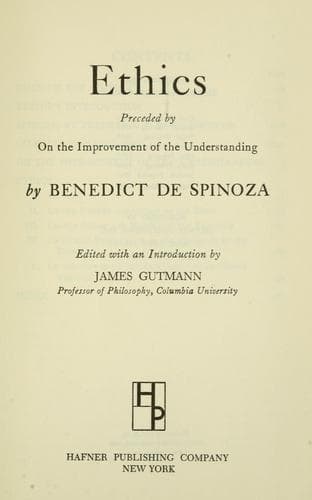
On the Improvement of the UnderstandingSpinoza, Benedictus de
PhilosophyPhilosophy
On the Improvement of the Understanding
Spinoza, Benedictus de
Free thought; Philosophy and religion
[65] (1) Let us shortly come to our conclusion, and again repeat
that we need have no fear of confusing with true ideas that which
is only a fiction. (2) As for the first sort of fiction of which
we have already spoken, when a thing is clearly conceived, we saw
that if the existence of a that thing is in itself an eternal truth
fiction can have no part in it; but if the existence of the
conceived be not an eternal truth, we have only to be careful
such existence be compared to the thing's essence, and to
consider the order of nature. (64:3) As for the second sort of
fiction, which we stated to be the result of simultaneously
directing the attention, without the assent of the intellect,
to different confused ideas representing different things and
actions existing in nature, we have seen that an absolutely
simple thing cannot be feigned, but must be understood, and that
a complex thing is in the same case if we regard separately the
simple parts whereof it is composed; we shall not even be able
to hypothesize any untrue action concerning such objects, for we
shall be obliged to consider at the same time the causes and manner
of such action.
[66] (1) These matters being thus understood, let us pass on to
consider the false idea, observing the objects with which it is
concerned, and the means of guarding ourselves from falling into
false perceptions. (2) Neither of these tasks will present much
difficulty, after our inquiry concerning fictitious ideas.
(3) The false idea only differs from the fictitious idea in the
fact of implying a mental assent--that is, as we have already
remarked, while the representations are occurring, there are no
causes present to us, wherefrom, as in fiction, we can conclude
that such representations do not arise from external objects:
in fact, it is much the same as dreaming with our eyes open,
or while awake. (67:4) Thus, a false idea is concerned with, or
(to speak more correctly) is attributable to, the existence of
a thing whereof the essence is known, or the essence itself, in
the same way as a fictitious idea.
[67] (1) If attributable to the existence of the thing, it is
corrected in the same way as a fictitious idea under similar
circumstances. (2) If attributable to the essence, it is
likewise corrected in the same way as a fictitious idea.
(67:3) For if the nature of the thing known implies necessary
existence, we cannot possible be in error with regard to its
existence; but if the nature of the thing be not an eternal
truth, like its essence, but contrariwise the necessity or
impossibility of its existence depends on external causes,
then we must follow the same course as we adopted in the
of fiction, for it is corrected in the same manner.
Public-domain text, read in full here on John Shaqi.
Reviews
Reviews
No reviews yet
Be the first to share your thoughts on this work.
Join the Discussion
Join the discussion
Sign in to leave a comment or review.
Sign InorCreate an account