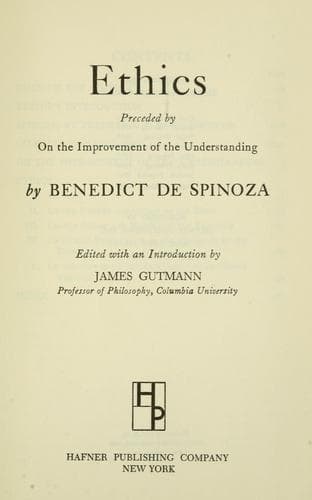
On the Improvement of the UnderstandingSpinoza, Benedictus de
PhilosophyPhilosophy
On the Improvement of the Understanding
Spinoza, Benedictus de
Free thought; Philosophy and religion
[68] (1) As for false ideas concerned with essences, or even
with actions, such perceptions are necessarily always confused,
being compounded of different confused perceptions of things
existing in nature, as, for instance, when men are persuaded
that deities are present in woods, in statues, in brute beasts,
and the like; that there are bodies which, by their composition
alone, give rise to intellect; that corpses reason, walk about,
and speak; that God is deceived, and so on. (68:2) But ideas which
are clear and distinct can never be false: for ideas of things
clearly and distinctly conceived are either very simple
themselves, or are compounded from very simple ideas, that is,
are deduced therefrom. (3) The impossibility of a very simple
idea being false is evident to everyone who understands the nature
of truth or understanding and of falsehood.
[69] (1) As regards that which constitutes the reality of truth,
it is certain that a true idea is distinguished from a false one,
not so much by its extrinsic object as by its intrinsic nature.
(2) If an architect conceives a building properly constructed,
though such a building may never have existed, and amy never exist,
nevertheless the idea is true; and the idea remains the same,
whether it be put into execution or not. (69:3) On the other hand,
if anyone asserts, for instance, that Peter exists, without
knowing whether Peter really exists or not, the assertion, as far
as its asserter is concerned, is false, or not true, even though
Peter actually does exist. (4) The assertion that Peter exists is
true only with regard to him who knows for certain that Peter does
exist.
[70] (1) Whence it follows that there is in ideas something real,
whereby the true are distinguished from the false. (2) This reality
must be inquired into, if we are to find the best standard of truth
(we have said that we ought to determine our thoughts by the given
standard of a true idea, and that method is reflective knowledge),
and to know the properties of our understanding. (70:3) Neither must
we say that the difference between true and false arises from the
fact, that true knowledge consists in knowing things through their
primary causes, wherein it is totally different from false knowledge,
as I have just explained it: for thought is said to be true, if
it involves subjectively the essence of any principle which has no
cause, and is known through itself and in itself.
Public-domain text, read in full here on John Shaqi.
Reviews
Reviews
No reviews yet
Be the first to share your thoughts on this work.
Join the Discussion
Join the discussion
Sign in to leave a comment or review.
Sign InorCreate an account