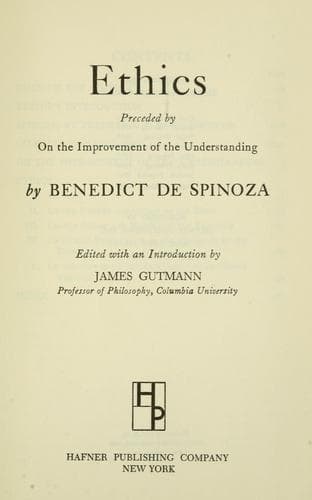
On the Improvement of the Understanding — John Shaqi
On the Improvement of the UnderstandingSpinoza, Benedictus de
PhilosophyPhilosophy
On the Improvement of the Understanding
Spinoza, Benedictus de
Free thought; Philosophy and religion
[71] (1) Wherefore the reality (forma) of true thought must exist
in the thought itself, without reference to other thoughts; it does
not acknowledge the object as its cause, but must depend on the
actual power and nature of the understanding. (2) For, if we
suppose that the understanding has perceived some new entity which
has never existed, as some conceive the understanding of God before
He created thing (a perception which certainly could not arise
any object), and has legitimately deduced other thoughts from said
perception, all such thoughts would be true, without being
determined by any external object; they would depend solely on the
power and nature of the understanding. (71:3) Thus, that which
constitutes the reality of a true thought must be sought in the
thought itself, and deduced from the nature of the understanding.
[72] (1) In order to pursue our investigation, let us confront
ourselves with some true idea, whose object we know for
certain to be dependent on our power of thinking, and to have
nothing corresponding to it in nature. (2) With an idea of this
kind before us, we shall, as appears from what has just been said,
be more easily able to carry on the research we have in view.
(72:3) For instance, in order to form the conception of a sphere,
I invent a cause at my pleasure--namely, a semicircle revolving
round its center, and thus producing a sphere. (4) This is
indisputably a true idea; and, although we know that no sphere in
nature has ever actually been so formed, the perception remains
true, and is the easiest manner of conceiving a sphere.
(72:5) We must observe that this perception asserts the rotation
of a semicircle--which assertion would be false, if it were not
associated with the conception of a sphere, or of a cause
determining a motion of the kind, or absolutely, if the assertion
were isolated. (6) The mind would then only tend to the
affirmation of the sole motion of a semicircle, which is not
contained in the conception of a semicircle, and does not arise
from the conception of any cause capable of producing such motion.
(72:7) Thus falsity consists only in this, that something is
affirmed of a thing, which is not contained in the conception
we have formed of that thing, as motion or rest of a semicircle.
(8) Whence it follows that simple ideas cannot be other than
true--e.g., the simple idea of a semicircle, of motion, of rest,
of quantity, &c.
(72:9) Whatsoever affirmation such ideas contain is equal to the
concept formed, and does not extend further. (10) Wherefore we
form as many simple ideas as we please, without any fear of error.
Public-domain text, read in full here on John Shaqi.
Reviews
Reviews
No reviews yet
Be the first to share your thoughts on this work.
Join the Discussion
Join the discussion
Sign in to leave a comment or review.
Sign InorCreate an account