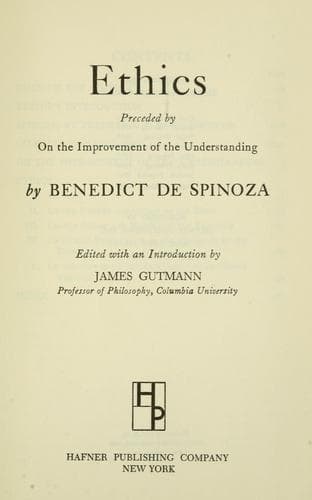
On the Improvement of the UnderstandingSpinoza, Benedictus de
PhilosophyPhilosophy
On the Improvement of the Understanding
Spinoza, Benedictus de
Free thought; Philosophy and religion
[73] (1) It only remains for us to inquire by what power our mind
can form true ideas, and how far such power extends. (2) It is
certain that such power cannot extend itself infinitely. (3) For
when we affirm somewhat of a thing, which is not contained in the
concept we have formed of that thing, such an affirmation shows a
defect of our perception, or that we have formed fragmentary or
mutilated ideas. (4) Thus we have seen that the notion of a
semicircle is false when it is isolated in the mind, but true when
it is associated with the concept of a sphere, or of some cause
determining such a motion. (73:5) But if it be the nature of a
thinking being, as seems, prima facie, to be the case, to form true
or adequate thoughts, it is plain that inadequate ideas arise in us
only because we are parts of a thinking being, whose thoughts--some
in their entirety, others in fragments only--constitute our mind.
[74] (1) But there is another point to be considered, which was not
worth raising in the case of fiction, but which give rise to complete
deception--namely, that certain things presented to the imagination
also exist in the understanding--in other words, are conceived
clearly and distinctly. (2) Hence, so long as we do not separate that
which is distinct from that which is confused, certainty, or the true
idea, becomes mixed with indistinct ideas. (3) For instance, certain
Stoics heard, perhaps, the term "soul," and also that the soul is
immortal, yet imagined it only confusedly; they imaged, also, and
understood that very subtle bodies penetrate all others, and are
penetrated by none. (74:4) By combining these ideas, and being at the
same time certain of the truth of the axiom, they forthwith became
convinced that the mind consists of very subtle bodies; that these
very subtle bodies cannot be divided &c.
[75] (1) But we are freed from mistakes of this kind, so long as we
endeavor to examine all our perceptions by the standard of the given
true idea. (2) We must take care, as has been said, to separate such
perceptions from all those which arise from hearsay or unclassified
experience. (3) Moreover, such mistakes arise from things being
conceived too much in the abstract; for it is sufficiently self-evident
that what I conceive as in its true object I cannot apply to anything
else. (75:4) Lastly, they arise from a want of understanding of the
primary elements of nature as a whole; whence we proceed without due
order, and confound nature with abstract rules, which, although they
be true enough in their sphere, yet, when misapplied, confound
themselves, and pervert the order of nature. (5) However, if we
proceed with as little abstraction as possible, and begin from primary
elements--that is, from the source and origin of nature, as far back
as we can reach,--we need not fear any deceptions of this kind.
Public-domain text, read in full here on John Shaqi.
Reviews
Reviews
No reviews yet
Be the first to share your thoughts on this work.
Join the Discussion
Join the discussion
Sign in to leave a comment or review.
Sign InorCreate an account