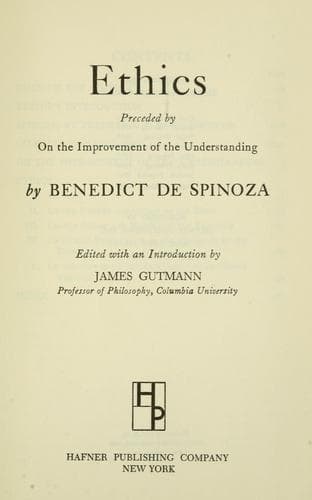
On the Improvement of the Understanding — John Shaqi
On the Improvement of the UnderstandingSpinoza, Benedictus de
PhilosophyPhilosophy
On the Improvement of the Understanding
Spinoza, Benedictus de
Free thought; Philosophy and religion
[76] (1) As far as the knowledge of the origin of nature is concerned,
there is no danger of our confounding it with abstractions. (2) For
when a thing is conceived in the abstract, as are all universal
notions, the said universal notions are always more extensive in the
mind than the number of individuals forming their contents really
existing in nature. (3) Again, there are many things in nature, the
difference between which is so slight as to be hardly perceptible to
the understanding; so that it may readily happen that such things are
confounded together, if they be conceived abstractedly. (4) But since
the first principle of nature cannot (as we shall see hereafter) be
conceived abstractedly or universally, and cannot extend further in
the understanding than it does in reality, and has no likeness to
mutable things, no confusion need be feared in respect to the idea of
it, provided (as before shown) that we possess a standard of truth.
(5) This is, in fact, a being single and infinite [76z]; in other
words, it is the sum total of being, beyond which there is no being
found. [76a]
[77] (1) Thus far we have treated of the false idea. We have now
to investigate the doubtful idea--that is, to inquire what can
cause us to doubt, and how doubt may be removed. (2) I speak of
real doubt existing in the mind, not of such doubt as we see
exemplified when a man says that he doubts, though his mind does
not really hesitate. (77:3) The cure of the latter does not fall
within the province of method, it belongs rather to inquiries
concerning obstinacy and its cure.
[78] (1) Real doubt is never produced in the mind by the thing
doubted of. (2) In other words, if there were only one idea in
the mind, whether that idea were true or false, there would be no
doubt or certainty present, only a certain sensation. (3) For an
idea is in itself nothing else than a certain sensation. (4) But
doubt will arise through another idea, not clear and distinct
enough for us to be able to draw any certain conclusions with
regard to the matter under consideration; that is, the idea which
causes us to doubt is not clear and distinct. (5) To take an example.
(78:6) Supposing that a man has never reflected, taught by experience
or by any other means, that our senses sometimes deceive us, he will
never doubt whether the sun be greater or less than it appears.
(7) Thus rustics are generally astonished when they hear that the
sun is much larger than the earth. (8) But from reflection on the
deceitfulness of the senses [78a] doubt arises, and if, after
doubting, we acquire a true knowledge of the senses, and how things
at a distance are represented through their instrumentality, doubt
is again removed.
Public-domain text, read in full here on John Shaqi.
Reviews
Reviews
No reviews yet
Be the first to share your thoughts on this work.
Join the Discussion
Join the discussion
Sign in to leave a comment or review.
Sign InorCreate an account