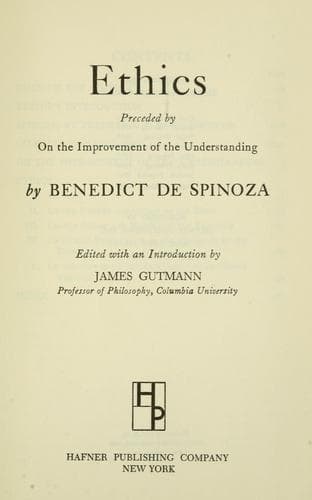
On the Improvement of the UnderstandingSpinoza, Benedictus de
PhilosophyPhilosophy
On the Improvement of the Understanding
Spinoza, Benedictus de
Free thought; Philosophy and religion
[79] (1) Hence we cannot cast doubt on true ideas by the supposition
that there is a deceitful Deity, who leads us astray even in what is
most certain. (2) We can only hold such an hypothesis so long as we
have no clear and distinct idea--in other words, until we reflect
the knowledge which we have of the first principle of all things, and
find that which teaches us that God is not a deceiver, and until we
know this with the same certainty as we know from reflecting on the
are equal to two right angles. (3) But if we have a knowledge of God
equal to that which we have of a triangle, all doubt is removed.
(79:4) In the same way as we can arrive at the said knowledge of a
triangle, though not absolutely sure that there is not some
arch-deceiver leading us astray, so can we come to a like knowledge
of God under the like condition, and when we have attained to it,
it is sufficient, as I said before, to remove every doubt which we can
possess concerning clear and distinct ideas.
[80] (1) Thus, if a man proceeded with our investigations in due
order, inquiring first into those things which should first be
inquired into, never passing over a link in the chain of association,
and with knowledge how to define his questions before seeking to
answer them, he will never have any ideas save such as are very
certain, or, in other words, clear and distinct; for doubt is only a
suspension of the spirit concerning some affirmation or negation
which it would pronounce upon unhesitatingly if it were not in
ignorance of something, without which the knowledge of the matter in
hand must needs be imperfect. (2) We may, therefore, conclude that
doubt always proceeds from want of due order in investigation.
[81] (1) These are the points I promised to discuss in the first part
of my treatise on method. (2) However, in order not to omit anything
which can conduce to the knowledge of the understanding and its
faculties, I will add a few words on the subject of memory and
forgetfulness.
(81:3) The point most worthy of attention is, that memory is
strengthened both with and without the aid of the understanding.
(4) For the more intelligible a thing is, the more easily is it
remembered, and the less intelligible it is, the more easily do we
forget it. (5) For instance, a number of unconnected words is much
more difficult to remember than the same number in the form of a
narration.
Public-domain text, read in full here on John Shaqi.
Reviews
Reviews
No reviews yet
Be the first to share your thoughts on this work.
Join the Discussion
Join the discussion
Sign in to leave a comment or review.
Sign InorCreate an account