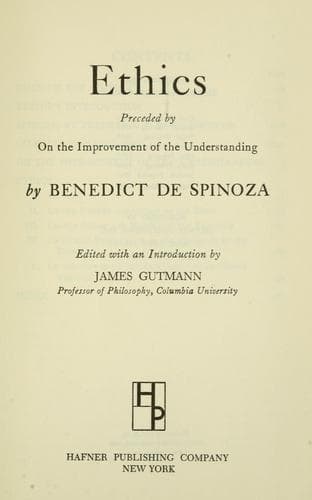
On the Improvement of the UnderstandingSpinoza, Benedictus de
PhilosophyPhilosophy
On the Improvement of the Understanding
Spinoza, Benedictus de
Free thought; Philosophy and religion
[82] (1) The memory is also strengthened without the aid of the
understanding by means of the power wherewith the imagination or
the sense called common, is affected by some particular physical
object. (2) I say particular, for the imagination is only affected
by particular objects. (3) If we read, for instance, a single romantic
comedy, we shall remember it very well, so long as we do not read
many others of the same kind, for it will reign alone in the memory
(4) If, however, we read several others of the same kind, we shall
think of them altogether, and easily confuse one with another.
(82:5) I say also, physical. (6) For the imagination is only
affected by physical objects. (7) As, then, the memory is
strengthened both with and without the aid of the understanding,
we may conclude that it is different from the understanding,
and that in the latter considered in itself there is neither
memory nor forgetfulness.
[83] (1) What, then, is memory? (2) It is nothing else than the
actual sensation of impressions on the brain, accompanied with the
thought of a definite duration, [83d] of the sensation. (3) This
is also shown by reminiscence. (4) For then we think of the
sensation, but without the notion of continuous duration; thus the
idea of that sensation is not the actual duration of the sensation
or actual memory. (83:5) Whether ideas are or are not subject to
corruption will be seen in philosophy. (6) If this seems too
absurd to anyone, it will be sufficient for our purpose, if he
reflect on the fact that a thing is more easily remembered in
proportion to its singularity, as appears from the example of
the comedy just cited. (83:7) Further, a thing is remembered more
easily in proportion to its intelligibility; therefore we cannot
help remember that which is extremely singular and sufficiently
intelligible.
[84] (1) Thus, then, we have distinguished between a true idea and
other perceptions, and shown that ideas fictitious, false, and the
rest, originate in the imagination--that is, in certain sensations
fortuitous (so to speak) and disconnected, arising not from the power
of the mind, but from external causes, according as the body,
sleeping or waking, receives various motions.
(2) But one may take any view one likes of the imagination so long
as one acknowledges that it is different from the understanding, and
that the soul is passive with regard to it. (3) The view taken is
immaterial, if we know that the imagination is something indefinite,
with regard to which the soul is passive, and that we can by some
means or other free ourselves therefrom with the help of the
understanding. (4) Let no one then be astonished that before proving
the existence of body, and other necessary things, I speak of
imagination of body, and of its composition. (5) The view taken is,
I repeat, immaterial, so long as we know that imagination is something
indefinite, &c.
Public-domain text, read in full here on John Shaqi.
Reviews
Reviews
No reviews yet
Be the first to share your thoughts on this work.
Join the Discussion
Join the discussion
Sign in to leave a comment or review.
Sign InorCreate an account