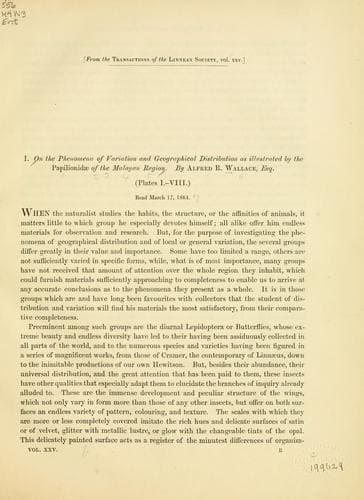
On the phenomena of variation and geographical distribution as illustrated by the Papilionidæ of the Malayan regionWallace, Alfred Russel
Science
On the phenomena of variation and geographical distribution as illustrated by the Papilionidæ of the Malayan region
Wallace, Alfred Russel
Papilionidae -- Malaysia -- Geographical distribution; Papilionidae -- Malaysia -- Variation
The fact of the two sexes of one species differing very considerably is
so common, that it attracted but little attention till Mr. Darwin showed
how it could in many cases be explained by what he termed sexual
selection. For instance, in most polygamous animals the males fight for
the possession of the females, and the victors, always becoming the
progenitors of the succeeding generation, impress upon their male
offspring their own superior size, strength, or unusually developed
offensive weapons. It is thus that we can account for the spurs and the
superior strength and size of the males in Gallinaceous birds, and also
for the large canine tusks in the males of fruit-eating Apes. So the
superior beauty of plumage and special adornments of the males of so
many birds can be explained by supposing (what there are many facts to
prove) that the females prefer the most beautiful and perfect-plumaged
males, and that thus slight accidental variations of form and colour
have been accumulated till they have produced the wonderful train of the
Peacock and the gorgeous plumage of the Bird of Paradise. Both these
causes have no doubt acted partially in insects, so many species
possessing horns and powerful jaws in the male sex only, and still more
frequently the males alone rejoicing in rich colours or sparkling
lustre. But there is here another cause which has led to sexual
differences, viz. a special adaptation of the sexes to diverse habits or
modes of life. This is well seen in female Butterflies (which are
generally weaker and of slower flight), often having colours better
adapted to concealment; and in certain South American species (_Papilio
torquatus_) the females, which inhabit the forests, resemble the _Æneas_
group, which abound in similar localities, while the males, which
frequent the sunny open riverbanks, have a totally different coloration.
In these cases, therefore, natural selection seems to have acted
independently of sexual selection; and all such cases may be considered
as examples of the simplest dimorphism, since the offspring never offer
intermediate varieties between the parent forms.
The distinctive character therefore of dimorphism is this, that the
union of these distinct forms does not produce intermediate varieties,
but reproduces them unchanged. In simple varieties, on the other hand,
as well as when distinct local forms or distinct species are crossed,
the offspring never resembles either parent exactly, but is more or less
intermediate between them. Dimorphism is thus seen to be a specialized
result of variation, by which new physiological phenomena have been
developed; the two should therefore, whenever possible, be kept
separate[4].
Footnote 4:
Public-domain text, read in full here on John Shaqi.
Reviews
Reviews
No reviews yet
Be the first to share your thoughts on this work.
Join the Discussion
Join the discussion
Sign in to leave a comment or review.
Sign InorCreate an account