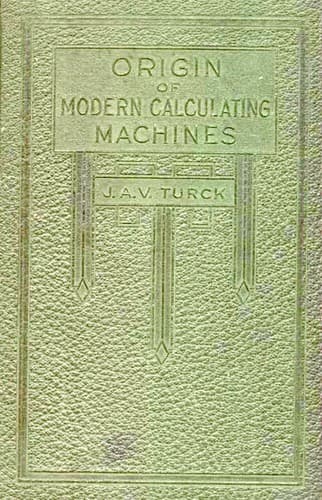
Origin of modern calculating machinesTurck, J. A. V.
History
Origin of modern calculating machines
Turck, J. A. V.
Calculators
The timing of the entry of the tooth of the detent is supposed to be
gauged to enter the right tooth, but as the action of these parts is
fast, slow or medium at the will of the operator, considerable time
must be allowed for variation in the entry of the detent tooth, which
requires space, as certain parts will fly ahead under the sudden impact
they may receive from a quick stroke, where they would not under a slow
stroke, but no allowance was provided for such contingency.
The means provided for the carry of the tens consist of the gears G⁹,
meshing with the numeral wheel gears and the single gear tooth g⁹,
attached to it, which, at each revolution of the lower wheel, as it
passes from 9 to 0, engages the gear of the numeral wheel of higher
denomination and was supposed to turn the higher gear one-tenth of a
revolution, thus registering one greater.
On account of the Gears G⁹, of one order and the gear tooth g⁹, of
another order operating on the same numeral wheel gear, the transfer
gears are arranged alternately on separate shafts, one at the side and
one below the numeral wheels.
[Sidenote: _Ludlum machine inoperative_]
The mechanical scheme disclosed in the Ludlum patent, to the
unsophisticated may seem to be operative. But to those familiar with
the Art of key-driven adding mechanism it will at once be obvious that
even if the typewriter feature was constructed properly the possibility
of correctly adding the items as they were printed was absolutely
impossible.
Laying aside several other features of inoperativeness, obvious to
those who know such mechanism, the reader, although not versed in the
Art of key-driven adding mechanism, will observe from the preceding
chapter, that the means provided for transferring the tens without
any control for the numeral wheels against over-rotation, would make
correct addition impossible.
The drawings and specification of the Ludlum patent disclose a mere
dream and show that they were not copied from the make-up of an
operative machine.
It was a daring scheme and one that none but a dreamer would undertake
to construct in the method shown. There have in later years been some
successful ten-key recording machines made and sold, but they were of a
very different design and principle.
There have also been several adding attachments made and sold that
could be adjusted to a regular commercial typewriter that are claimed
to be dependable, but none of these machines were early enough to be
claimed as the first operative recording-adding machine, or the first
adding machine in which the principle used for the legible recording of
the numerical items used in the machines of today may be found.
[Illustration]
FIRST PRACTICAL RECORDERS
Public-domain text, read in full here on John Shaqi.
Reviews
Reviews
No reviews yet
Be the first to share your thoughts on this work.
Join the Discussion
Join the discussion
Sign in to leave a comment or review.
Sign InorCreate an account