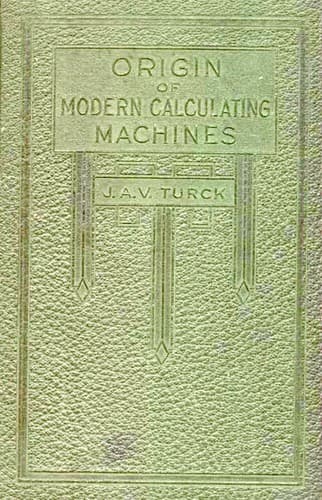
Origin of modern calculating machinesTurck, J. A. V.
History
Origin of modern calculating machines
Turck, J. A. V.
Calculators
[Sidenote: _First individualized type impression combined with printing
sector_]
As the printing in this Felt invention was by individualized type
impression, legibility of recording as well as accurate addition was
obtained. Although this patent shows that Felt had produced such an
operative combination, there are two features in this patent which
would prevent its becoming a marketable machine.
One of these features was that of having to wind the motor spring that
furnished power for the type impression. The other feature was that
there was no provision for printing the ciphers. Although the ciphers
were always omitted from the keyboard of non-recording adders, as they
could perform no function in addition or other forms of calculation,
they could not without inconvenience, be eliminated from items in
recording.
THE SECOND FELT RECORDER
[Sidenote: _First practical arithmetical recorder_]
While the last-described Felt patent was still pending, Felt improved
his mechanism for recording, installing new features and eliminating
the objectionable features referred to. These improvements were of
such a satisfactory nature that the Felt & Tarrant Mfg. Co. made
twenty-five recording-adders, with the new features, which were sold to
various banks. The first of these machines was placed on trial with the
Merchants & Manufacturers National Bank of Pittsburgh, Pa., in December
of 1889.
Good evidence of the practical features of this machine was set forth
in a testimonial given at the time by W. A. Shaw, the cashier of the
bank, after it had been given a six months’ test. This testimonial is
extant and has been reproduced on opposite page.
[Sidenote: _The first sale of a recording-adding machine on record_]
Records show that the bank purchased that “Comptograph,” which was the
trade name given the Felt recording-adder, and used it until 1899, at
which time this machine, along with others of the same make purchased
at a later date, were replaced by the bank with “Comptographs” of more
modern type.
This Felt recording machine was without question the first practical
recording-adding machine ever sold that would produce legible printed
records of items and totals under the variable conditions that have to
be met in such a class of recording.
[Illustration: Testimonial]
[Illustration: Felt Recording and Listing Machine.
Purchased and Used for Ten Years by the Merchants & Manufacturers Bank
of Pittsburgh, Pa.
Machine is now in the National Museum at Washington]
Public-domain text, read in full here on John Shaqi.
Reviews
Reviews
No reviews yet
Be the first to share your thoughts on this work.
Join the Discussion
Join the discussion
Sign in to leave a comment or review.
Sign InorCreate an account