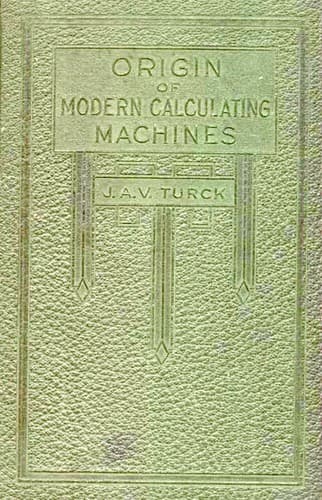
Origin of modern calculating machinesTurck, J. A. V.
History
Origin of modern calculating machines
Turck, J. A. V.
Calculators
Thus, if the five-hundred-dollar key should be depressed, only the
trigger latch in that order need be tripped. This is brought about
through the fact that normally the tripping-dogs 718 are held out
of tripping engagement by the cam surface y of the type-sector, as
the rock-frame in which the dogs are mounted is moved forward in its
tripping action. But as the hundred-dollar order type-sector has been
lifted through the setting of the (5) key in that order, it allows the
tripping-dog to engage the trigger-latch of that order, and through
the overlapping feature of the trigger-latches to trip and print the
ciphers to the right.
It will be noted that the application of the printing-hammers varied in
detail from that of Felt much the same as placing the latch on the gate
post instead of on the gate. In the generic principle, however, the
individual hammer-blow for each individual impression was maintained.
[Sidenote: _Date of use of first practical Burroughs recorder_]
There have been many conflicting statements made regarding the date of
the first Burroughs listing or recording machine, which is probably due
to the fact that the statements were not qualified by such terms as
“practically operative” or “legible recording.”
Dates given as that of the first Burroughs recording machine range from
1884 to 1892. In a book published by the Burroughs Co. in 1912, under
the title of the “Book of the Burroughs,” there was a statement that
the first practical machines were made in 1891.
[Illustration: From the February 1908 Issue of Office Appliances
Magazine]
H. B. Wyeth, at one time sales agent for the Burroughs Co., and
whose father was president of the company in 1891 and several years
thereafter, testified in court that the first sale of a Burroughs
recording machine was made about December, 1892. Corroboration of his
testimony is set forth in a Burroughs advertisement which appeared
in the February number of Office Appliances Magazine in 1908, a
reproduction of which is shown on the opposite page.
That Burroughs was experimenting as early as 1885 is no doubt correct;
and that in this respect he antidated Felt’s first attempt to produce a
recording-adder, is not questioned. But when it comes to the question
of who produced the first practical recording-adder, there is no room
for doubt in face of the evidence at hand.
[Illustration]
Introduction of the Modern Accounting Machine
Public-domain text, read in full here on John Shaqi.
Reviews
Reviews
No reviews yet
Be the first to share your thoughts on this work.
Join the Discussion
Join the discussion
Sign in to leave a comment or review.
Sign InorCreate an account