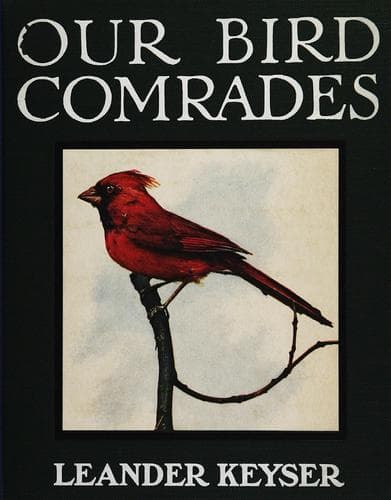
Our Bird ComradesKeyser, Leander S. (Leander Sylvester)
History
Our Bird Comrades
Keyser, Leander S. (Leander Sylvester)
Birds
Then I would perhaps make a half-hearted attempt to get a glimpse of
the lyrist, but it kept itself well hidden in the bushes, and I
desisted, begrudging the time taken from my quest for feathered
rarities. But one day, while strolling along the banks of a small
stream, I again heard the labored ditty, and the next moment a small
bird darted into full view, calling and scolding in an agitated way,
and, while I watched it capering about, it broke into the very song to
which for several weeks I had been listening so carelessly. Why, it
was not a wren after all! It did not look like a wren, nor act like
one, but, rather, its form and conduct were like those of a vireo; and
a vireo it was. My bird manual soon settled that point. And what was
the name of the little stranger who had introduced himself in so
informal a way? It was the Bell vireo, an entirely new species to me.
It is not an eastern species; it ranges from Illinois to the base of
the Rocky Mountains. In Kansas it is a summer resident, hanging its
little basket of a nest on the twigs of bushes or low trees, after the
regular vireo fashion. It was my good fortune to find a nest on a
copsy hilltop, where the bird's madrigals and lullabies mingled with
those of the yellow-breasted chats, the indigo buntings, the blue-gray
gnat catchers, and the Kentucky warblers. To this day I feel a longing
to visit the secluded spot where I held so many pleasant interviews
with these birds.
Another Kansas bird that was new to my eyes and that afforded me much
delight was the Harris sparrow--a distinctively western species, not
known, or at least very rarely, east of the Mississippi River. He is
truly a fine bird, a little larger than the fox sparrow, neatly clad,
his breast prettily decorated with a brooch of black spots held in
place by a slender necklace of the same color, while his throat and
forehead are bordered with black. His rump and upper tail coverts are
a delicate shade of grayish brown, by which he may be readily
distinguished from the fox sparrow, whose rear parts are reddish brown.
His beak, feet, and legs are of a pinkish tint, making him look quite
trig and dressy. The latest of the spring arrivals were the most
highly colored, having the whole chin, throat, and top of the head a
glossy, uniform black.
Public-domain text, read in full here on John Shaqi.
Reviews
Reviews
No reviews yet
Be the first to share your thoughts on this work.
Join the Discussion
Join the discussion
Sign in to leave a comment or review.
Sign InorCreate an account