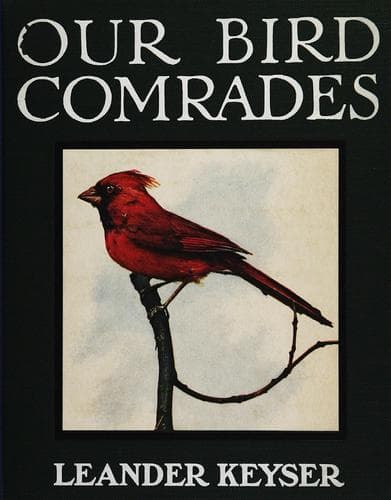
Our Bird ComradesKeyser, Leander S. (Leander Sylvester)
History
Our Bird Comrades
Keyser, Leander S. (Leander Sylvester)
Birds
It would appear that the most matured individuals migrate farthest
south in winter. That, at least, would be the natural conclusion,
judging from the fact that they arrive latest in the spring in our
central latitudes. In the southern part of Kansas the Harris sparrows
are said to be common winter sojourners, but in the north-eastern part
of the state they disappeared in November or December, and did not
return until the middle of February, or later if the weather happened
to be severe. From the time of their vernal arrival they were to be
seen in every ramble until they took flight for their breeding haunts
in the North. One spring some of them were still loitering in Kansas
on the eleventh of May, and were singing blithely, no doubt waiting for
the winter cold of their summer homes to be well past before they
ventured farther toward the arctic lands.
In general, the habits of these birds are much like those of the
white-throated sparrows, which are much more common in the East than in
the West. The Harris sparrows are fond of copses and hedges, and
especially of brush heaps in new grounds. So marked, indeed, is their
penchant for brush heaps that I almost wish one might re-christen them
"brush-heap sparrows." Many a time I have played a little trick on the
unsuspecting birds by stealing up to a brush pile and giving it a
sudden blow with my cane; then a whole covey of them would dash
pellmell from their covert with loud chirps of protest against such
wantonness.
Sometimes they are found in the depths of the woods, providing there is
thick underbrush in which they can conceal themselves. I seldom found
them in open places either in the woods or fields. Yet, shy as they
are, they have a fondness for the dense hedges along the highways,
flitting and chirping as the traveler passes by.
Being wary birds, they do not wander far from their hiding places, into
which they precipitate themselves at the approach of a supposed danger.
It was quite a while before I could get a clear view of their breasts,
for, with provoking persistence, they kept their tails turned toward
me. However, when once you really become acquainted with a bird, it
seems to lose part of its shyness, and so after a time I often had the
Harris sparrows in plain view. One of their characteristic habits was
to stand at full height on the top of a brush heap, with tail lifted,
crest feathers erect, and eyes wide open, the picture of wild
alertness. In such poses they are indeed handsome birds.
Public-domain text, read in full here on John Shaqi.
Reviews
Reviews
No reviews yet
Be the first to share your thoughts on this work.
Join the Discussion
Join the discussion
Sign in to leave a comment or review.
Sign InorCreate an account