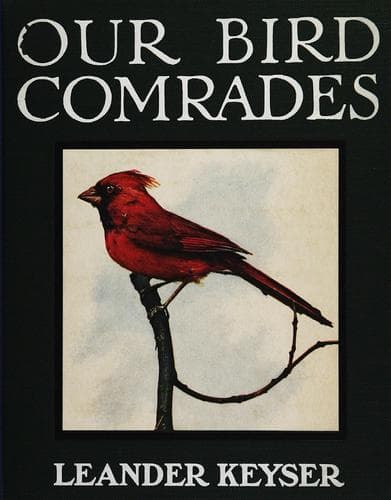
Our Bird ComradesKeyser, Leander S. (Leander Sylvester)
History
Our Bird Comrades
Keyser, Leander S. (Leander Sylvester)
Birds
It was March 5, 1898, when I heard the first song of this sparrow, and
even then it was only a fragment of a song. But, the weather remaining
pleasant, the sixteenth of the month brought a fine concert. The
bird's song was a surprise to me. It began with a prolonged run so
much like the opening tremolo of the white-throated sparrow that it
might have led the most expert ornithologist astray. The fact is, I
looked around for quite a while in search of a white-throat, thinking
him still a little out of tune, and therefore unable to finish his
chanson; and I was undeceived only by the singing of several Harris
sparrows that with unusual boldness had perched in plain sight. The
resemblance ceased, however, with the opening notes, for the western
bird did not add the sweet, rhythmic triad of his white-throated
cousin, the closing part of his song being only a somewhat labored
trill of no distinct character, and not fulfilling the promise of his
initial strain.
In the concerts of these birds--and frequently many of them would be
trilling at the same time--they sang in several different keys, some of
them striking the treble and others dropping almost to the alto.
Occasionally two birds in different parts of a field would sing
responsively, one trill running very high in the scale, the other an
octave lower. It seemed almost as if the responsive exercise was
engaged in intentionally.
The Harris sparrow has another song which is quite unlike his melodious
trill. It is delivered in a loud voice of little musical quality, and
the notes are pounded out in a percussive style, like the explosion in
quick succession of a number of little cartridges. Yet you must be
quite close to the bird in order to hear the queer canticle distinctly,
and when you do hear it you will wonder why nature ever put such a song
into a bird's larynx. The Harris sparrow also utters an explosive
alarm-call, which expresses not a little petulance and concern.
One day a pretty picture was made by two of these birds that stood face
to face on a brush heap, bowing at each other, each threatening to peck
the other's head off, and both singing all the while at the top of
their voices, yet each afraid, in spite of his bluster, to close with
his opponent in actual contest. It was a miniature exhibition of the
beak-to-beak challenging often indulged in by two rival cocks of the
farmyard. For some minutes the little farce was kept up, then one of
the birds became tired of the game and darted over to the next brush
heap.
Public-domain text, read in full here on John Shaqi.
Reviews
Reviews
No reviews yet
Be the first to share your thoughts on this work.
Join the Discussion
Join the discussion
Sign in to leave a comment or review.
Sign InorCreate an account